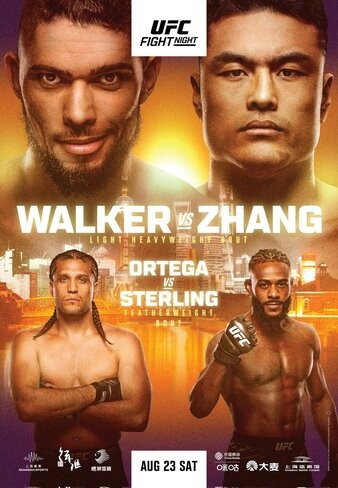
GPTZhang Mingyang's striking output (9.23 SLPM at 57% accuracy) is significantly higher and more accurate than Johnny Walker's, and Zhang absorbs more but defends at a higher rate. Walker's durability has been questionable against powerful strikers, and Zhang's aggressive style and finishing instinct are likely to exploit that. Walker's grappling is not a consistent path and Zhang has shown strong offensive pressure.
GPTSterling holds clear statistical advantages in strike differential (+2.31 vs Ortega's -2.51), striking accuracy (52% vs 37%), and striking defense (58% vs 49%). His higher output and superior ability to avoid damage (SApM 2.3 vs 6.59) suggest he will control the pace at range. While Ortega is dangerous with submissions, Sterling's own grappling is elite, with greater takedown volume (2.31 vs 1.07), and he has rarely been finished. Ortega's leaky striking defense and tendency to absorb high damage make a finish unlikely against a high-output, defensively-sound opponent like Sterling.
GPTPavlovich is an elite power puncher with a proven track record of early knockouts against top-tier heavyweights. While Cortes-Acosta displays solid striking volume, high accuracy, and a positive strike differential, he has not faced anyone with Pavlovich's finishing ability. Pavlovich's reach advantage (+6 inches) and aggressive style are likely to overcome Cortes-Acosta's more methodical approach and modest grappling threat.
GPTSumudaerji holds a significant edge in striking accuracy, strike differential, and defensive metrics. He absorbs far fewer strikes than Borjas and lands at a higher accuracy rate. Borjas' defensive liabilities, high strikes absorbed per minute, and lack of grappling or submission threat make it likely he will be outpointed over three rounds. While neither fighter has strong finishing rates at this level, Sumudaerji's superior technical striking and defense should secure him a clear decision.
CLAUDESimplified prediction due to API limitations. Basic statistical comparison used.
GPTNueraji's significantly higher striking volume (11.01 SLpM) and superior striking differential (+3.62) suggest he can outwork Crosbie over three rounds. While Crosbie is more accurate (64% vs 48%), Nueraji's pace and defensive edge (58% vs 54% StrDef) give him the upper hand in a pure striking affair. Both lack grappling threat, so this should remain a standup contest where Nueraji's output is the difference.
CLAUDESimplified prediction due to API limitations. Basic statistical comparison used.
GPTGauge Young enters with a significant striking accuracy advantage (56% vs 28%) and higher output (4.27 SLpM). Both fighters are defensively vulnerable, absorbing over 5 strikes per minute, but Young's accuracy and volume should allow him to outpoint Maheshate in a likely striking battle, given neither attempts takedowns. Maheshate's physical advantages are minor and unlikely to offset the technical disparity in striking.
CLAUDESimplified prediction due to API limitations. Basic statistical comparison used.
GPTKavanagh's superior striking accuracy (66%) and higher strike output (4.97 SLpM) give him an edge in a likely standup battle, especially since neither fighter is a significant grappling threat. Johnson is more defensively sound and has some wrestling ability, but his low takedown accuracy (23%) and Kavanagh's high striking efficiency suggest the fight will favor Kavanagh's pace and precision over three rounds.
CLAUDESimplified prediction due to API limitations. Basic statistical comparison used.
GPTHubbard's superior striking defense and more favorable strike differential suggest he will absorb less damage while maintaining competitive output. Rongzhu is more aggressive but absorbs more strikes than he lands, and Hubbard's takedown defense should limit Rongzhu's wrestling success. Both have low finishing rates, making a decision outcome likely.
CLAUDESimplified prediction due to API limitations. Basic statistical comparison used.
GPTPereira's superior striking accuracy, volume, and defensive metrics give him an advantage in a likely standup-heavy fight. Daukaus presents a significant submission threat, but his low takedown accuracy and Pereira's strong takedown defense reduce his chances of controlling the fight on the ground. Pereira's dynamic striking and ability to avoid extended grappling exchanges favor him over three rounds.
CLAUDESimplified prediction due to API limitations. Basic statistical comparison used.
GPTYizha shows better striking metrics, higher takedown accuracy and defense, and absorbs significantly less damage than Wilson. Wilson's high submission average is offset by low takedown accuracy and poor defensive stats, making it unlikely he can control Yizha long enough to secure a finish. Yizha's overall defensive efficiency and grappling control should allow him to nullify submission threats and win on points.
CLAUDESimplified prediction due to API limitations. Basic statistical comparison used.
GPTSuYoung You's elite grappling volume (6 takedowns per fight, 63% accuracy) should dictate the pace and location of the fight. While Xiao Long has a clear striking advantage in both volume and accuracy, his takedown defense (78%) will be tested at a much higher frequency than he's faced before. You's superior striking defense (64%) and ability to stifle offense make it likely he can neutralize Long's output and control rounds on the mat.
CLAUDESimplified prediction due to API limitations. Basic statistical comparison used.
GPTDiyar Nurgozhay has a substantial statistical edge, with proven UFC-level output (3.52 SLpM at 52% accuracy, 66% striking defense), excellent distance management, and perfect takedown defense. Satybaldiev's complete lack of UFC stats introduces significant uncertainty about his readiness and effectiveness against a defensively sound striker. Unless Satybaldiev reveals a major stylistic advantage or grappling threat, Nurgozhay's activity and efficiency should control the fight.

 0