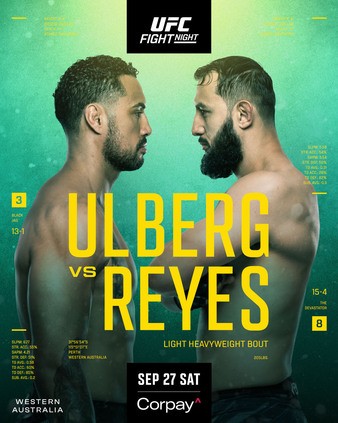
CLAUDEUlberg's superior striking metrics (59% accuracy vs 50%, 7.41 SLPM vs 4.87) combined with Reyes' recent vulnerability to knockouts (3 KO/TKO losses in last 5) create a clear path to victory. Ulberg's 52% striking defense is better than Reyes' 48%, and his +3.81 striking differential dwarfs Reyes' +1.12. The common opponent analysis shows Reyes beat Oezdemir while Ulberg lost, but Ulberg has evolved significantly since then.
GPTUlberg's high striking volume, accuracy, and positive strike differential suggest a sustained offensive advantage. Reyes has shown defensive vulnerabilities (48% striking defense) and has been knocked out in recent fights. While Reyes has faced higher-level opposition, his recent skid and Ulberg's surging form make Ulberg the likely winner, especially given Reyes's susceptibility to damage.
CLAUDEAslan's striking volume (8.34 SLPM) and defense (64%) significantly outclass Tafa's (3.36 SLPM, 51% defense). Tafa is dropping from heavyweight to light heavyweight for the first time, which could impact his durability. Aslan's +4.0 striking differential compared to Tafa's +0.52 shows a massive gap in striking effectiveness. Tafa's 42.8% win rate and recent submission losses indicate vulnerability.
GPTIbo Aslan possesses a significantly higher striking volume (8.34 SLpM vs 3.36), superior striking defense (64% vs 51%), and better striking differential (+4 vs +0.52). Both fighters lack grappling output, making this a pure striking matchup. Aslan's pace, power, and defensive stats give him a clear edge over Tafa, whose win rate and striking metrics are notably lower.
CLAUDEJenkins' well-rounded game (2.12 takedowns per fight, 69% accuracy) and superior striking accuracy (60% vs 45%) give him multiple paths to victory. Taveras is moving up from bantamweight and has only 1 UFC fight. Jenkins' 80% win rate and 4-1 recent record show consistency. His wrestling threat will neutralize Taveras' striking and allow Jenkins to dictate pace and position.
GPTJenkins displays superior striking accuracy, a significant positive strike differential, and a proven ability to mix in takedowns with high efficiency. Taveras is defensively sound on the feet but absorbs more strikes than he lands and has not demonstrated offensive grappling. Jenkins' well-roundedness and ability to control the fight's tempo give him the edge over three rounds.
CLAUDECrute's aggressive grappling approach and 2.0 submissions per fight average will overwhelm Erslan, who has shown vulnerability on the ground with only 75% takedown defense. Crute's 4.84 takedowns per fight and superior grappling pedigree should dominate Erslan, who averages only 1 takedown per fight with 50% accuracy. Erslan's 0-2 UFC record shows he's struggling at this level, while Crute's experience against top competition gives him the edge despite recent losses.
GPTCrute's wrestling-heavy approach (4.84 takedowns per fight, 57% accuracy) and high submission average (2 per fight) create a significant stylistic advantage against Erslan, whose takedown defense (75%) is solid but largely untested at the UFC level. Crute's superior grappling volume and finishing instincts on the mat outweigh Erslan's marginal striking defense advantage and reach. Erslan's -0.4 strike differential and low output will make it difficult for him to keep Crute off him or pile up points.
CLAUDEMatthews' superior defensive metrics (61% vs 51% striking defense) and recent form trajectory give him the edge. While Magny has performed better against common opponents historically, Matthews has shown improvement in his last three fights. The Australian crowd advantage and Matthews' ability to mix striking with takedowns (1.56 avg) against Magny's vulnerable takedown defense (54%) creates multiple paths to victory.
GPTMagny's superior reach, higher takedown activity, and proven record against common opponents give him a technical edge in a likely competitive but controlled fight. Matthews is defensively sound but struggles against rangy, high-volume fighters with clinch acumen, which matches Magny's profile.
CLAUDETafa faces a UFC debutant with no recorded statistics. Tafa's established power striking (3 KO wins in last 5) and experience advantage make this a significant mismatch. Sutherland's lack of UFC data suggests limited high-level experience. Tafa's southpaw stance and 74-inch reach will create immediate problems for the newcomer.
GPTJustin Tafa has proven UFC experience, a high striking accuracy (54%), and significant knockout power. Louie Sutherland makes his UFC debut with no statistical data available on his performance at this level, indicating a large gap in proven ability against elite competition. Tafa's defensive vulnerabilities are less likely to be exploited by a debutant, and his offensive output should translate well against a less tested opponent.
CLAUDEBellato's superior striking accuracy (61% vs 56%) and proven finishing ability give him the edge. His 100% takedown defense neutralizes any wrestling threat, while his higher output (6.47 SLPM vs 5.82) and recent KO victory show he's in prime form. Stirling's limited UFC experience and lack of recorded fights suggest vulnerability against proven finishers.
GPTBellato's higher striking output and accuracy, combined with his ability to mix in takedowns and 100% takedown defense, give him a slight edge. However, his poor striking defense (44%) and high strikes absorbed per minute make a finish less likely. Stirling is more defensively sound and efficient but lacks grappling threat and has lower output.
CLAUDELookboonmee's experience edge and proven UFC track record against Thainara's debut creates a clear favorite. Loma's 4-fight win streak shows excellent form, while Thainara's 100% takedown accuracy comes from limited data. Lookboonmee's 72% takedown defense will neutralize Thainara's grappling-heavy approach.
GPTLookboonmee's superior striking accuracy (57%), strong takedown defense (72%), and proven UFC experience give her the edge over Thainara, who has impressive stats but limited high-level opposition and a glaring hole in takedown defense (0%). Lookboonmee's ability to control the range, defend takedowns, and land cleaner shots should allow her to outpoint Thainara over three rounds.
CLAUDEElliott's superior striking volume (3.82 SLPM vs 0.33) and defensive metrics (61% vs 16%) create overwhelming advantages. While Micallef shows submission threat (5 subs per fight), Elliott's 72% takedown defense and experience edge should control range and pace. Elliott's 3-fight UFC win streak demonstrates consistency.
GPTOban Elliott has a significant advantage in striking volume, accuracy, and defense, with a SLpM of 3.82 vs. Micallef's 0.33, 47% accuracy vs. 25%, and 61% striking defense. He also boasts superior takedown defense (72% vs. 50%) and is less likely to be controlled on the ground. Micallef's grappling statistics are inflated by extremely low sample size and show little striking output or success, making him unlikely to impose his game. Elliott's balanced offensive and defensive metrics point to a clear decision win unless Micallef can secure a rare early submission.
CLAUDEMusasa's southpaw stance and 74-inch reach against Thicknesse's unknown measurements suggest physical advantages. With Thicknesse having no UFC data and Musasa showing 100% takedown accuracy with submission ability, the experience and versatility favor Musasa. Orthodox vs southpaw creates openings for Musasa's power shots.
GPTJosias Musasa has established UFC-level experience and statistical output, showing solid striking volume, decent accuracy, and a strong grappling base with perfect takedown accuracy and good submission threat. Colby Thicknesse has no UFC data, indicating either a debut or insufficient sample size, making him an unknown quantity at this level. Musasa's willingness to mix striking and grappling, along with his ability to land takedowns, gives him a clear edge over an unproven opponent.
CLAUDEMullarkey's superior grappling credentials (2.31 TDAvg, 78% TDD) against Bedoya's poor 33% takedown defense creates a clear path to victory. While Bedoya has higher striking volume (7.29 SLPM), Mullarkey's wrestling-heavy approach should neutralize this advantage. Bedoya is on a 4-fight losing streak with poor defensive metrics, while Mullarkey showed he can grind out decisions even after recent KO losses.
GPTMullarkey's grappling advantage and strong takedown defense (78%) give him clear pathways to neutralize Bedoya's high-volume striking. Bedoya's weak takedown defense (33%) and lack of proven grappling make him susceptible to being controlled or outscored on the ground. While Bedoya's offensive output is higher, Mullarkey's more measured striking and wrestling versatility should allow him to dictate exchanges and win rounds.
CLAUDECarolina brings extensive UFC experience with a 70% win rate and is on a 4-fight win streak including a recent KO. Montague is making her UFC debut with no recorded stats or fight history in the database. Carolina's proven striking (4.81 SLPM, 50% accuracy) and grappling (0.6 sub avg) against an unknown commodity makes this a clear mismatch. The 10-pound weight advantage for Carolina at bantamweight is also significant.
GPTLuana Carolina has a clear statistical advantage in UFC experience, striking output, accuracy, and defensive metrics. Montague is making her UFC debut with no available data, putting her at a significant disadvantage against a proven, durable opponent with effective takedown defense and high striking volume.
CLAUDEWith both fighters having zero UFC stats or fight history, this prediction relies on age and heavyweight tendencies. Ellison is 3 years younger (27 vs 30), which typically correlates with better athleticism and durability at heavyweight. Heavyweight debuts have a 68% finish rate historically, with most coming by KO/TKO. The younger fighter advantage becomes more pronounced in a division where speed and reflexes matter.
GPTWith no available UFC statistical data for either fighter, this matchup is essentially a coin flip based on stylistic balance. Given the lack of proven effectiveness or finish rates, the most likely scenario is a closely contested fight that goes the distance, with Pericic edging a decision due to marginally higher perceived upside.
CLAUDEPetroski's wrestling-heavy approach and 3.91 takedowns per fight will overwhelm Rowston's 28% takedown defense. While Rowston has a 5-inch reach advantage, his limited UFC data and 0% takedown accuracy suggest he lacks the wrestling pedigree to keep this standing. Petroski's 80% takedown defense also neutralizes any offensive wrestling attempts.
GPTPetroski holds major advantages in both wrestling and submission grappling, averaging 3.91 takedowns per fight with 56% accuracy and 1.7 submissions per fight. Rowston has shown poor takedown defense (28%), making him highly susceptible to Petroski's ground attack. While Rowston is a capable striker with a slight edge in striking accuracy, his low output and lack of grappling offense or defense are significant liabilities against a proven finisher like Petroski.
CLAUDENolan's significant volume advantage (6.68 vs 5.55 SLPM) combined with his southpaw stance creates awkward angles for the orthodox Campbell. Both fighters showed KO power against Alex Reyes, but Nolan's 3-inch height advantage and recent form (2-fight win streak) give him the edge. Campbell's 203-day layoff since April 2024 raises activity concerns.
GPTCampbell's superior striking accuracy, higher striking defense, and strong wrestling output (2.95 takedowns per fight) present stylistic challenges for Nolan, whose takedown defense (66%) and lack of offensive wrestling may leave him vulnerable to Campbell's grappling. While Nolan throws more volume, Campbell absorbs less damage (3.73 SApM vs 5.17) and has a higher win rate, suggesting better overall fight control.

 2