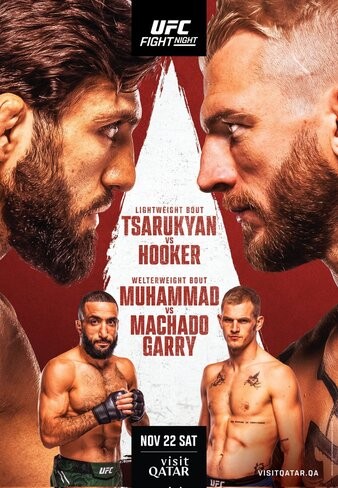
CLAUDETsarukyan's superior wrestling (3.25 takedowns per fight vs 0.73) and excellent takedown defense (75%) will neutralize Hooker's striking volume advantage. While Hooker lands 5.03 strikes per minute compared to Tsarukyan's 3.79, Arman's 53% striking defense and ability to mix in takedowns will disrupt Hooker's rhythm. Tsarukyan has shown improved striking power with recent KO wins, and his 4-fight win streak demonstrates championship-level consistency. Hooker's vulnerability to grapplers (78% TDD vs Tsarukyan's 37% accuracy suggests successful takedowns) and recent damage absorption make him susceptible to control-heavy gameplan.
CLAUDEMuhammad's elite takedown defense (89%) and relentless pressure wrestling (2.28 takedowns per fight) present significant problems for Garry's striking-heavy approach. While Garry has better striking metrics (55% accuracy vs 43%, 5.5 SLPM vs 4.39), Muhammad's experience edge and proven ability to neutralize strikers through clinch control and cage wrestling will be decisive. Garry's 69% takedown defense is solid but untested against elite wrestlers. Muhammad's 5-fight win streak includes victories over elite competition, while Garry remains unproven at championship level. The 4-inch height disadvantage for Muhammad is mitigated by his pressure style and durability.
CLAUDEOezdemir's technical striking superiority and momentum advantage make him a strong favorite. He's on a 4-fight win streak with 2 KOs and a submission, while Menifield has lost 4 of his last 5, all by KO/TKO. Volkan's 55% striking defense compared to Menifield's 49% shows better defensive responsibility. Their common opponent analysis heavily favors Oezdemir - he's 4-0 against shared opponents while Menifield is 2-2. Menifield's chin has been compromised recently, absorbing significant damage in consecutive losses. Oezdemir's measured approach and power striking at range should find the target against Menifield's aggressive but defensively porous style.
CLAUDEThis is a fascinating clash between a veteran middleweight dropping to welterweight and an undefeated prospect. Hermansson's significant weight cut from 185 to 170 is extremely concerning - that's a 15-pound drop for a 36-year-old fighter. Orolbai's elite wrestling (7.44 takedowns per fight at 44% accuracy) will be the deciding factor. While Hermansson has better striking volume (5.09 vs 3.02 SLPM), Orolbai's wrestling-heavy approach and 30-pound youth advantage will wear down the weight-depleted veteran. Orolbai has shown he can go the distance, and his grappling control will neutralize Hermansson's experience edge.
CLAUDECortes Acosta holds significant striking volume advantage (5.53 vs 2.43 SLPM) and better defensive metrics (55% vs 44%). While Gaziev has shown knockout power and better takedown success, his recent KO loss raises durability concerns. Cortes Acosta's 2-inch reach advantage and superior output should control distance effectively. Gaziev's 30% takedown accuracy is concerning against Cortes Acosta's 72% TDD.
GPTCortes Acosta's superior striking volume, accuracy, and defensive efficiency give him a statistical edge over Gaziev, who absorbs more strikes than he lands and has lower striking defense. While Gaziev's grappling is more active, his low takedown accuracy and Acosta's solid takedown defense (72%) limit his ability to control the fight on the ground. With both fighters having similar physical stats and no clear finishing rates, Acosta's consistent output and favorable striking differential suggest he will outpoint Gaziev over three rounds.
CLAUDEUlanbekov's grappling-heavy approach (3.71 TDAvg, 2.1 SubAvg) presents major problems for Horiguchi, who hasn't competed in UFC since 2016. The 8-year layoff is massive at flyweight. Ulanbekov's recent submission victories show his ground game is sharp, while Horiguchi's 55% TDD and zero submission average indicate vulnerability on the mat. The southpaw vs orthodox dynamic favors Ulanbekov's entries.
GPTKyoji Horiguchi holds a significant striking differential (+1.15 vs -0.08), better striking defense (62% vs 51%), and a 4-inch reach advantage. While Ulanbekov offers higher submission threat (2.1 submissions per fight) and more takedown volume, Horiguchi's superior footwork, speed, and proven ability to handle grapplers at a high level (as shown in his Bellator and RIZIN career) make him the favorite to outpoint Ulanbekov over three rounds. Ulanbekov's path is grappling-heavy, but Horiguchi's historically strong scrambling and defensive discipline limit finishing threats.
CLAUDELimited data on Riley makes this difficult, but Grad's 15-3 record and UFC experience provide the edge. Grad's 6.35 SLPM output and 2.75 TDAvg suggest a well-rounded approach. Riley being undefeated (11-0) is impressive but untested at UFC level. Grad's poor defensive metrics (49% StrDef, 0% TDD) are concerning, but Riley has zero UFC stats to analyze. Experience typically wins in these scenarios.
GPTBogdan Grad has significant statistical advantages in striking volume, accuracy, and grappling activity, while Luke Riley's UFC-level data is unavailable. Grad's high output (6.35 SLPM) and aggressive takedown attempts (2.75 per fight) suggest he can dictate the pace. However, Grad's poor defensive metrics (10.25 SApM, 0% TD defense) raise some risk, but Riley's unknowns limit confidence in an early finish.
CLAUDEDespite limited UFC stats data for Izagakhmaev, his 22-2 record and recent form suggest elite-level skills. Dalby shows vulnerability with back-to-back decision losses and inconsistent striking accuracy (43%). Izagakhmaev's wrestling-heavy background from the Caucasus region typically translates to strong grappling pressure that can neutralize Dalby's balanced approach. Dalby's 58% takedown defense is concerning against a fresh grappler making his UFC debut.
GPTDalby is a durable, high-volume striker with decent takedown defense, but his 58% TD defense is exploitable. Izagakhmaev, despite no UFC stats, is a proven elite grappler in other promotions (notably under Khabib's tutelage). Dalby has struggled against strong wrestlers and can be controlled on the mat. If Izagakhmaev implements a heavy wrestling gameplan, he should be able to neutralize Dalby's output and win rounds via control, but Dalby's durability and scrambling limit finish opportunities.
CLAUDEAlmabayev's perfect 5-0 UFC record with dominant wrestling (5.08 takedowns per fight at 50% accuracy) presents a nightmare matchup for Perez. While Perez has superior striking volume (4.19 vs 2.11 SLPM), Almabayev's 1.7 submissions per fight and relentless grappling pressure will likely dictate the fight. Perez's recent 1-4 record including multiple KO losses suggests declining durability, while Almabayev is peaking with 5 straight unanimous decisions.
GPTAlmabayev's superior grappling volume and submission threat should allow him to control most positions. While Perez is the more experienced UFC fighter with better striking output and takedown defense, Almabayev's relentless wrestling pace (5.08 TDs per fight, 1.7 subs per fight) and high striking accuracy (56%) give him the edge over three rounds. Perez's takedown defense (77%) will slow Almabayev, but not enough to keep the fight standing for long stretches.
CLAUDEYakhyaev's striking metrics are extraordinary - 32 SLPM with 88% accuracy and 66% defense compared to Cerquiera's poor 1.61 SLPM with 44% accuracy and 36% defense. The southpaw vs orthodox matchup favors Yakhyaev's superior volume and accuracy. Cerquiera absorbs 4.88 strikes per minute while landing only 1.61, creating a massive -3.27 differential. Yakhyaev's 100% takedown defense also negates any grappling threats.
GPTYakhyaev's overwhelming striking output (32 SLpM, 88% accuracy, +30 differential) and strong defensive statistics (66% striking defense, 100% takedown defense) indicate a dominant stand-up performance. Cerquiera absorbs far more strikes than he lands (4.88 SApM vs 1.61 SLpM, 36% defense), suggesting he will struggle with Yakhyaev's pace and precision. Grappling is likely a non-factor given both have 0 takedown attempts and Yakhyaev's superior takedown defense.
CLAUDEThis matchup presents significant data limitations, but Almakhan's concerning 18% striking accuracy and -4.33 striking differential from his lone UFC appearance suggests major technical deficiencies. While Topuria lacks UFC data, his brother Ilia's elite pedigree and the Topuria family's strong wrestling/grappling background indicate superior fundamentals. Almakhan absorbed 4.53 strikes per minute while landing only 0.2, demonstrating poor defense and offense. Topuria likely possesses the technical advantages to control range and avoid Almakhan's limited offense.
GPTBoth fighters have extremely limited UFC data, but Almakhan has at least some offensive activity and cage experience at this level, whereas Topuria has no measurable output or demonstrated effectiveness. Almakhan's minuscule striking output and low defense are concerning, but with Topuria showing no data, Almakhan's marginal UFC exposure gives him a slight edge in a likely low-action fight.
CLAUDELoder's striking metrics are exceptional - 80% accuracy with 6.16 strikes landed per minute and a +6.01 differential. His recent KO victories demonstrate finishing power at middleweight. Naurdiev's 52% accuracy and lower volume (3.17 SLPM) combined with just 68% striking defense makes him vulnerable to Loder's precise, high-volume attack. The southpaw vs orthodox matchup favors Loder's power shots. Naurdiev hasn't competed since 2020 and was primarily a welterweight, suggesting ring rust and size disadvantages. Loder's 100% takedown defense neutralizes Naurdiev's wrestling threat.
GPTLoder's statistical profile is dominant across key areas: he lands strikes at nearly double the rate of Naurdiev with vastly higher accuracy (80% vs 52%), absorbs almost no damage (SApM 0.15 vs 1.3), and boasts a perfect 100% takedown defense. Critically, his submission average (2.2 per fight) far exceeds Naurdiev's (0.2), and Naurdiev has shown only average takedown defense (70%). Loder's physical advantages and southpaw stance further complicate the matchup for Naurdiev, who has not demonstrated equivalent finishing ability or offensive output.
CLAUDEAliev brings proven UFC experience with a 100% win rate and well-rounded skillset. His 3.06 takedowns per fight at 44% accuracy gives him a clear grappling path against Rock, who has zero UFC data. Aliev's +2.04 striking differential and 59% defense show competent standup to complement his wrestling. Rock's lack of any UFC statistics makes him a complete unknown at this level. The orthodox vs southpaw dynamic could favor Aliev's wrestling entries. Aliev's youth (24 years old) and momentum from his recent win suggest he's ascending while Rock faces the UFC learning curve.
GPTNurullo Aliev has a significant statistical edge, showing a strong wrestling base (3.06 takedowns per fight, 44% accuracy) and excellent defensive metrics (0.46 SApM, 59% striking defense). Shem Rock has no verifiable UFC data, indicating a lack of proven performance at this level. Aliev's control and ability to avoid damage suggest he can dictate the tempo and location of the fight, most likely grinding out a decision.
CLAUDEThis heavyweight debut presents limited UFC data, but Freeman's 6-1 regional record provides crucial insight. His recent split with Kelton Sneve (1-1) and draws with Sheeley suggest competitive fights at the regional level. The southpaw vs orthodox dynamic favors Freeman's awkward angles against a debuting Bujlo. Freeman's experience edge (7 pro fights vs Bujlo's UFC debut) and proven ability to go the distance in 4 of his last 5 fights indicates superior fight IQ and cardio management. Bujlo's 3-inch height advantage is neutralized by identical reach, allowing Freeman to work inside effectively.
GPTWith both fighters lacking UFC-level statistical data, the prediction leans very slightly toward Denzel Freeman due to the stylistic note that both have balanced games and there is no clear physical or technical edge. The lack of data and neutral matchup means this is a low-confidence, decision-based prediction.

 0