Fight Genie logo Fight Genie
UFC Fight Night · August 29, 2026Final

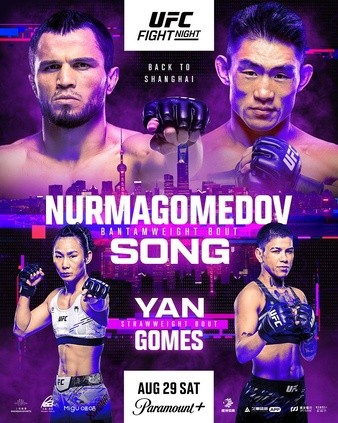
NurmagomedovvsSong

13Bouts
11Agree
2Splits
1Locks
UFC Fight Night: Nurmagomedov vs. Song poster
Card complete. Claude 9/13 (69%)  ·  GPT 7/13 (54%)Results
The locksBoth models 75%+ on the same fighter
RedBlue Bar: model avg Market KO Sub Dec
Main card
01
LOCKNurmagomedov
Main cardFinal: Yadong, KO/TKO Punch
Umar Nurmagomedov
Umar
8-1UFC
30 yrs
VS
Bantamweight
Song YadongWINNER
Song
12-5UFC
28 yrs
Claude + GPT
76%NurmagomedovYadong24%
CLAUDE Umar Nurmagomedov 76% DecisionMISS
GPT Umar Nurmagomedov 76% DecisionMISS
Why
CLAUDEThe market (-520, 79% de-vigged) and Elo (54%) disagree sharply here, and the truth sits closer to the market. Elo underrates Umar because his 10-fight UFC sample is short but loaded with elite names, and his lone loss came in a competitive five-rounder against Merab Dvalishvili, the best bantamweight alive. The common-opponent ledger is damning for Song: Umar went 4-0 against shared opposition including a clean decision over Cory Sandhagen, whom Song was stopped by, and both beat Figueiredo. Statistically the fight is lopsided in the phases that matter: Umar absorbs just 1.86 SApM against Song's 3.81, lands at 56% accuracy versus Song's 43%, and averages 4.03 takedowns per fight against a 73% takedown defense that has cracked against elite chain-wrestlers (Merab, Yan both grounded Song). Song's path is a single counter right hand or check hook in scrambles, real but narrow, and Umar's 61% striking defense and low-exposure southpaw-style karate movement minimize those windows. Umar's 0% finish rate over his last five signals how this ends: five rounds of takedowns, back-takes, and point-heavy kickboxing. The 211-day layoff is routine for him (career average 221 days between fights). Umar by wide decision, with a late submission as the live secondary outcome if Song fades chasing the fight.
GPTNurmagomedov's superior defensive striking, accuracy, and high-frequency wrestling should allow him to dictate range and control extended portions of the fight. He absorbs only 1.86 significant strikes per minute compared with Song's 3.81 and owns a much stronger striking differential of +2.00 versus +0.53. Song's 73% takedown defense and dangerous boxing should make the exchanges competitive, but Nurmagomedov's 4.03 takedowns per fight, layered entries, and ability to mix kicks with grappling project as the more reliable five-round approach.
Stats
02
Main cardSPLITFinal: Gomes, KO/TKO Elbow
Yan Xiaonan
Yan
9-4UFC
37 yrs17 mo out
VS
Women's Strawweight
Denise GomesWINNER
Denise
5-3UFC
26 yrs
ClaudeGPT
57%XiaonanGomes43%
CLAUDE Denise Gomes 56% DecisionHIT
GPT Yan Xiaonan 69% DecisionMISS
Why
CLAUDEThis is my one deliberate disagreement with the market (Yan -170, 59%). The factor being underweighted is the compound of age and inactivity: Yan is 37 years old and enters on a 498-day layoff, well past the ~450-day threshold where ring rust becomes a material, measurable risk, and her last outing was a decision loss to Virna Jandiroba in which she was controlled for long stretches. Meanwhile Gomes, 26, has won four straight, is riding a +19 Elo trend against Yan's -12, and has visibly improved her decision-making since the Angela Hill loss (her only recent blemish). The counterargument is real: Yan's opposition quality (Zhang Weili, Jandiroba, Andrade, Dern) dwarfs Gomes's (Pennington, Reed, Kowalkiewicz), and Yan's 4.69 SLpM at 60% defense beats Gomes's 51% defense on paper. But those career numbers were built by a younger Yan, and strawweights on the wrong side of 35 tend to fall off a cliff in hand speed, exactly the attribute her volume-boxing style depends on. Gomes hits hard for the division (KO of Reed, KO of Yazmin Jauregui previously), pushes a physical pace, and can mix in takedowns (1.45 TD/fight) against Yan's mediocre 64% TDD. Expect Gomes to walk Yan down, win exchanges in the second half as the layoff shows, and take a close decision, with the Shanghai crowd unable to swing the scorecards.
GPTYan Xiaonan's cleaner distance striking, nine-point advantage in significant-strike defense, and slightly stronger striking differential should allow her to win exchanges while limiting Gomes' power. Gomes offers more takedown and submission activity, but her 34% takedown accuracy makes sustained control uncertain, and Yan owns the better result against their common opponent.
Stats
03
Main cardFinal: Asakura, KO/TKO Punches
Aoriqileng
4-6UFC
33 yrs
VS
Bantamweight
Kai AsakuraWINNER
Kai
1-2UFC
32 yrs
Claude + GPT
36%AoriqilengAsakura64%
CLAUDE Kai Asakura 61% KO/TKO, R2HIT
GPT Kai Asakura 68% KO/TKO, R2HIT
Why
CLAUDENo market line provided, so this leans on Elo (52/48 Asakura, though his rating is provisional at 3 UFC fights) and the stylistic read. This is a pure striker-vs-striker matchup, and it favors Asakura's cleaner weapons against Aoriqileng's deteriorating durability. Aoriqileng absorbs a brutal 5.66 SApM with only 46% striking defense, the worst defensive profile on this card, and was just knocked out by a knee from Cody Haddon 85 days ago. A quick turnaround after a KO loss is a durability red flag. Asakura's raw UFC stats (34% accuracy, 2.53 SLpM) look poor, but they're polluted by two fights spent surviving grappling exchanges against Pantoja and Elliott at flyweight, a weight cut that clearly drained him. His move up to bantamweight, his natural weight from his Rizin championship run, immediately produced a first-round KO of Smotherman where his counter power and timing looked like the fighter who twice beat Kyoji Horiguchi. Critically, Aoriqileng cannot exploit Asakura's true weakness: he's a striker with only 1.11 TD/fight, not the submission grappler (Elliott, Pantoja) who accounts for both Asakura losses. A kickboxing match against a hittable, recently-concussed opponent is the best matchmaking Asakura could ask for. Confidence capped by his 3-fight UFC sample and Aoriqileng's own power (KO of Gibson) making this a live firefight.
GPTAsakura's UFC statistics come from a limited and difficult sample, but his speed, counterpunching, and proven finishing power outside the UFC give him the higher offensive ceiling. Aoriqileng lands at greater volume, yet absorbs 5.66 significant strikes per minute with only 46% defense and a -1.26 striking differential. That defensive vulnerability should give Asakura opportunities to land damaging counters during exchanges. Aoriqileng can threaten with pressure and takedowns, but his 1.11 takedowns per 15 minutes and low submission activity are unlikely to provide sustained control.
Stats
04
Main cardFinal: Sumudaerji, U-DEC
Alex Perez
Alex
8-6UFC
34 yrs
VS
Flyweight
SumudaerjiWINNER
6-4UFC
30 yrs
Claude + GPT
63%PerezSumudaerji37%
CLAUDE Alex Perez 59% KO/TKO, R2MISS
GPT Alex Perez 67% Submission, R2MISS
Why
CLAUDEThis is an immediate rematch of their May 2026 no-contest, and the underlying matchup data leans toward Perez despite Sumudaerji's home-region advantage in Shanghai. The common-opponent evidence is the sharpest signal available: Perez knocked out Charles Johnson in round one in January 2026, while Sumudaerji dropped a clear unanimous decision to the same fighter in 2024. That contrast maps directly onto their profiles, Perez carries real one-punch finishing ability (KO wins over Johnson and Nicolau in his last four victories, 80% recent finish rate) plus a genuine wrestling dimension (2.07 TD/15min at 45% accuracy against Sumudaerji's 73% TD defense and near-zero offensive wrestling at 0.76 TD avg). Sumudaerji is the more polished pure striker on paper, 72-inch reach at 5'8, southpaw, 50% accuracy, 2.11 strike differential, and a three-fight decision win streak, but his 0% finish rate across his last five and losses whenever the competition steps up (Johnson, Elliott sub loss) cap his ceiling. Elo agrees at 53/47 Perez with a +36 trend for Sumudaerji, so this is genuinely competitive, but Perez has more paths: he can win exchanges with counters, land the fight-changing right hand, or lean on takedowns to bank rounds. The risks are Perez's known durability issues (KO loss to Taira, sub loss to Almabayev when hurt) and the 7-inch reach deficit against a rangy southpaw. If Sumudaerji keeps it at kicking range for 15 minutes he decisions Perez, but Perez's pressure and power have historically broken opponents at this level of striker.
GPTSumudaerji owns the cleaner long-range striking profile, landing 4.40 significant strikes per minute with a +2.11 differential and a seven-inch reach advantage. Perez, however, has the stronger matchup-specific path through pressure wrestling, averaging 2.07 takedowns with 45% accuracy and 0.8 submissions. His better performance against common opponent Charles Johnson also supports Perez's ability to navigate Sumudaerji's length. Perez is likely to close distance, force scrambles, and capitalize on Sumudaerji's historical vulnerability during extended grappling exchanges.
Stats
05
Main cardFinal: Ce, KO/TKO Punch
Liu CeWINNER
Liu
VS
Light Heavyweight
Levi Rodrigues Jr.
Levi
29 yrs
ClaudeGPT
64%CeRodrigues36%
CLAUDE Liu Ce 58% KO/TKO, R1HIT
GPT Liu Ce 70% KO/TKO, R2HIT
Why
CLAUDEData is minimal here and both fighters are effectively debutants from a UFC statistical standpoint, so confidence must be capped and this read is built from context rather than metrics. What we do know cuts against Rodrigues: he was knocked out by Felipe Franco with punches just 38 days before this bout in July 2026, and his DWCS appearance ended in a no-contest that was also stopped on strikes. Taking a light heavyweight fight on a five-and-a-half-week turnaround immediately after a KO loss is a material durability and preparation red flag, recovery protocols alone make a full camp impossible, and fighters returning that quickly from concussive losses historically underperform. Liu Ce (3-1) is the unknown quantity, but he is the promoted local fighter on a Shanghai card, which typically signals the matchmakers believe he is the developmental asset in this pairing; UFC debutants booked at home against opponents coming off stoppage losses are usually positioned to win. Light heavyweight fights involving low-experience fighters skew heavily toward early stoppages, and Rodrigues' 100% finish involvement rate (in both directions) suggests this doesn't see the scorecards. The honest caveat: we have zero film-equivalent data on Liu Ce's striking defense or grappling, and Rodrigues has legitimate finishing power himself, if Liu Ce's chin is untested at this level, this could flip violently. Confidence stays modest at 58.
GPTThe available data are limited, but Rodrigues' defensive profile is a major concern: he absorbs 4.6 significant strikes per minute while landing 2.6, producing a -2.0 differential, and his 29% striking defense leaves him highly vulnerable in sustained exchanges. Liu is favored to exploit those defensive gaps with forward pressure and power, although the lack of reliable statistics for Liu lowers confidence.
Stats
Prelims
06
PrelimsFinal: Lima, SUB Guillotine Choke
Namsrai Batbayar
Namsrai
25 yrs
VS
Flyweight
Andre LimaWINNER
Andre
4-0UFC
27 yrs18 mo out
Claude + GPT
35%BatbayarLima65%
CLAUDE Andre Lima 62% DecisionHIT
GPT Andre Lima 68% DecisionHIT
Why
CLAUDEBatbayar is a UFC debutant coming off the Road to UFC pipeline with three straight finishes (KO by knee, RNC, KO by punch), so his statistical profile must be treated as unverified against UFC-level opposition, none of his listed metrics carry meaningful sample weight. Lima, despite dropping a decision to Kevin Borjas in June, has four UFC wins and a genuinely elite efficiency profile: 56% striking accuracy against only 2.66 SApM absorbed, a +1.28 strike differential, and 75% takedown defense. The step up from Road to UFC regional opposition to a proven UFC flyweight is historically one of the hardest jumps in the sport. Batbayar's 100% finish rate on the regional circuit is eye-catching but came against opponents like Yin Shuai and Agulali, not UFC-calibre fighters. Lima's decision-heavy path (three of five wins by decision) and Batbayar's aggression suggest Lima weathers early danger, uses his 3-inch height advantage and cleaner counter-striking to bank rounds. The market's 69% on Lima is roughly right, though the debutant's finishing dynamism keeps genuine variance in this fight, hence confidence capped well below the market's conviction.
GPTLima projects as the cleaner and more defensively responsible striker. He holds advantages in significant-strike accuracy (56% to 45%), striking defense (58% to 48%), strikes absorbed per minute (2.66 to 3.42), and striking differential (+1.28 to +1.02). Batbayar's higher volume and takedown activity create competitive phases, but his 30% takedown accuracy may struggle against Lima's 75% takedown defense. Lima's 60% takedown accuracy also gives him a useful secondary path to secure close rounds. With both fighters averaging submission activity but limited evidence of sustained ground dominance, Lima winning a competitive decision is the most likely outcome.
Stats
07
PrelimsFinal: Woodson, S-DEC
Jack Jenkins
Jack
4-2UFC
32 yrs
VS
Featherweight
Sean WoodsonWINNER
Sean
8-2UFC
34 yrs17 mo out
ClaudeGPT
38%JenkinsWoodson62%
CLAUDE Sean Woodson 57% DecisionHIT
GPT Sean Woodson 67% DecisionHIT
Why
CLAUDEThis is closer than the -164 line suggests, and the single biggest red flag sits on the favorite's side: Woodson enters off a 498-day layoff following a KO loss to Dan Ige, the exact profile (long absence + last memory is getting finished) that produces ring rust and hesitancy. That said, the structural matchup still favors him. Woodson holds a massive 10-inch reach advantage (78 vs 68) and 7 inches of height, and his 5.57 SLPM volume from range is precisely the style that has troubled shorter pressure fighters. Jenkins is the more accurate striker (61% vs 46%) but has to cross a canyon of distance to land, and his path to victory, wrestling at 1.98 TD/fight with 60% accuracy, runs into Woodson's 84% takedown defense. Elo agrees with the market almost exactly (59% Woodson), and both fighters trend positively. Jenkins' own durability concern (KO'd by Mariscal, submitted by Santos when fights got chaotic) means Woodson's jab-and-move game can accumulate. I take Woodson but at reduced confidence: the layoff exceeds the 450-day risk threshold and Jenkins' activity (330 days vs 498) and leg-kick/wrestle-mix approach make him a very live underdog.
GPTWoodson's 10-inch reach advantage, higher striking output, and strong 84% takedown defense should allow him to control range and win exchanges over three rounds. Jenkins is more accurate and can threaten with wrestling, but his 1.98 takedowns per fight may be difficult to sustain against Woodson's defensive grappling. Woodson absorbs more strikes, so competitive moments are likely, but his length and volume give him the stronger round-winning profile.
Stats
08
PrelimsFinal: Tsuruya, SUB Rear Naked Choke
Rei TsuruyaWINNER
Rei
1-1UFC
24 yrs18 mo out
VS
Flyweight
Kevin Borjas
Kevin
1-3UFC
28 yrs12 mo out
Claude + GPT
75%TsuruyaBorjas25%
CLAUDE Rei Tsuruya 72% Submission, R2HIT
GPT Rei Tsuruya 78% DecisionHIT
Why
CLAUDEThere is real tension here between the market (-650, 82% Tsuruya) and Elo (56% Tsuruya, both ratings provisional), and the resolution lies in the stylistic read the Elo model cannot see. Tsuruya is a relentless chain wrestler averaging 5.03 takedowns per fight with a 2.0 submission average, coming off a fresh RNC finish of Luis Gurule. Borjas is a pure striker with zero recorded takedowns and no submission threat whose negative strike differential (-1.40, absorbing 5.27 SApM) means he doesn't even clearly win the phase where he lives. Borjas' 72% takedown defense is respectable but has never been tested by anyone with Tsuruya's shot volume, against 5+ attempts per fight, a 28% failure rate per attempt means he hits the mat multiple times. The common opponent (Joshua Van) beat both by decision, offering no separation, but Tsuruya's loss came against a future contender while Borjas is 1-3 in his last four UFC-recorded bouts with a KO loss to Imanol Rodriguez sandwiched in. The 82% market number is slightly rich given Tsuruya's two-fight UFC sample and modest striking (2.4 SLPM, 43% defense) if the fight stays standing, but the grappling funnel is overwhelming. Tsuruya drags this into deep water and finds the neck by round two.
GPTTsuruya's high-frequency wrestling and submission threat should dictate the matchup. He averages 5.03 takedowns and 2.0 submission attempts per 15 minutes, while Borjas offers no offensive grappling and absorbs 5.27 significant strikes per minute with a -1.40 striking differential. Borjas' 72% takedown defense could prevent an early finish, but repeated entries, control time, and positional offense favor Tsuruya over three rounds.
Stats
09
PrelimsFinal: Polastri, KO/TKO Kick
Xiong Jingnan
Xiong
0-1UFC
38 yrs
VS
Women's Strawweight
Julia PolastriWINNER
Julia
2-3UFC
28 yrs
Claude + GPT
38%JingnanPolastri62%
CLAUDE Julia Polastri 61% DecisionHIT
GPT Julia Polastri 64% DecisionHIT
Why
CLAUDEXiong arrives with a huge name from her ONE Championship title reign, but her lone UFC data point was sobering: she was out-pointed by Angela Hill while absorbing a massive 8.13 significant strikes per minute with only 38% striking defense and 34% accuracy, a -3.6 strike differential. At 38 years old, her reaction time appears to be eroding against UFC-level volume strikers. Polastri, ten years younger, is exactly that archetype: 6.22 SLpM at 56% accuracy with 59% defense, a +1.04 differential, and she carries opportunistic grappling (80% TD accuracy on selective attempts). Polastri's losses have come to grinding wrestlers (Alencar, Godinez) and slick counter-strikers, not to fighters who plant and trade, which is Xiong's game. The Elo model narrowly favors Polastri (52/48) despite Xiong's provisional rating being inflated by reputation. Home crowd in Shanghai helps Xiong emotionally, but the pace differential over three rounds should let Polastri bank rounds behind volume. Xiong's power keeps her live, so confidence stays moderate.
GPTPolastri owns the stronger statistical profile, landing at a higher rate and accuracy while absorbing substantially fewer strikes. Her positive striking differential contrasts sharply with Xiong's negative differential, and her takedown threat should further disrupt Xiong's boxing rhythm. Xiong's experience and power make the matchup competitive, but her low defensive rate and high absorption favor Polastri over three rounds.
Stats
10
PrelimsFinal: Hasan, KO/TKO Punch
Bilal HasanWINNER
Bilal
25 yrs
VS
Flyweight
Nilson Rojas
Nilson
27 yrs
Claude + GPT
66%HasanRojas34%
CLAUDE Bilal Hasan 65% KO/TKO, R2HIT
GPT Bilal Hasan 67% KO/TKO, R1HIT
Why
CLAUDEThis is a matchup of two undefeated fighters where neither has a completed UFC bout, so statistical inference must lean on the market, DWCS footage, and physical profile rather than UFCStats fields. The market is emphatic: Hasan -650 (82% de-vigged), a strong-consensus 64-point spread. Hasan just blitzed Mridul Saikia by KO on DWCS twelve days ago, an extremely short turnaround that signals he took no damage and the UFC fast-tracked him for this Shanghai card. He's 9-0 with a 100% finish rate in tracked bouts, a 5'7" frame with a 70-inch reach that is enormous for flyweight, and a switch stance that complicates entries for the orthodox Rojas. Rojas is also 9-0 but with no tape against comparably vetted opposition, and taking a debut against a hyped, longer, in-rhythm finisher on short notice is a brutal assignment. Per debutant protocol, confidence is capped at 65 despite the lopsided line, unknown-vs-unknown fights carry irreducible variance.
GPTHasan is the pick based on the only meaningful statistical evidence available: exceptionally high reported striking output, 80% accuracy, and a +24 striking differential. His switch stance should also create favorable angles against Rojas' orthodox stance. Rojas has no usable UFC striking or grappling data, however, and Hasan's extreme numbers likely come from a very small sample, limiting confidence. If Rojas cannot force an unproven grappling phase, Hasan's pressure and clean offense favor an early stoppage.
Stats
11
PrelimsSPLITFinal: Nuzzi, KO/TKO Punches
Xiao Long
Xiao
1-3UFC
28 yrs
VS
Bantamweight
Francesco NuzziWINNER
Francesco
30 yrs
ClaudeGPT
53%LongNuzzi47%
CLAUDE Francesco Nuzzi 58% DecisionHIT
GPT Xiao Long 64% DecisionMISS
Why
CLAUDEXiao Long's UFC ledger tells a consistent story: a durable, decent-volume striker (5.06 SLpM, 47% accuracy, 82% TD defense) who keeps fights competitive but loses the decisive exchanges, he's 1-3 in the UFC and rides two straight decision losses to Garbrandt and SuYoung You. His 20% finish rate and 50% striking defense mean he neither breaks opponents nor avoids being out-pointed. Nuzzi is the classic dangerous debutant: 11-2 with European title-level experience, a fresh southpaw look at 29 years old entering his athletic prime, and no UFC tape for Xiao Long's camp to study. The southpaw-vs-orthodox dynamic historically troubles Xiao Long, whose offense is built on orthodox boxing entries. Home crowd in Shanghai and Xiao Long's proven UFC-level durability keep this close, and the 169-day layoff is not concerning. But Xiao Long's pattern of losing tight decisions to fresher, technically sharper opponents is exactly the trap this booking presents. With no market line and Nuzzi being a debutant, confidence is appropriately modest.
GPTXiao Long has the stronger measurable UFC-level profile, producing 5.06 significant strikes per minute with a positive +1.21 striking differential and solid 82% takedown defense. His 50% striking defense leaves openings, particularly in the orthodox-versus-southpaw matchup, but Nuzzi's absent UFC statistical sample makes it difficult to establish a reliable advantage in either phase. Xiao's pace, defensive wrestling, and likely ability to bank rounds favor him over three rounds, although the limited information on Nuzzi keeps confidence moderate.
Stats
12
PrelimsFinal: Santiago, KO/TKO Punch
Lawrence Lui
Lawrence
1-0UFC
30 yrs
VS
Bantamweight
Hector SantiagoWINNER
Hector
33 yrs
Claude + GPT
66%LuiSantiago34%
CLAUDE Lawrence Lui 64% DecisionMISS
GPT Lawrence Lui 67% DecisionMISS
Why
CLAUDELui enters with genuine momentum: a 3-fight win streak including a UFC 325 decision over Sulangrangbo and a Road to UFC knockout, and his profile (5.3 takedowns per fight attempted, 100% takedown defense in his lone UFC outing, +0.40 striking differential) points to a control-grappler who imposes pace and position. Santiago (6-1) is a UFC debutant with no octagon data, his stats are nulls, not weaknesses, so uncertainty is real. The market prices Lui at 71% (-310), which is a reasonable prior; the 42-point spread reflects Lui's proven regional-scheme wins and Shanghai crowd advantage against an unknown quantity. Lui's finish rate is modest (33% recently, both UFC-adjacent decisions), and his 39% striking accuracy suggests he wins rounds rather than moments. With a debutant on the other side and Lui's grinding tendencies, a takedown-heavy decision is the most probable path. Confidence is capped due to Santiago's data vacuum, a debutant with a 6-1 record can always carry unseen power or submission craft.
GPTLui is the more supportable pick because he has demonstrated positive striking defense and differential alongside a high-output wrestling game. His 5.3 takedown average, 40% takedown accuracy, and reported 100% takedown defense give him multiple ways to control rounds. Santiago has no meaningful UFC statistical sample, limiting confidence and making a finish difficult to project.
Stats
13
PrelimsFinal: Nelson, U-DEC
Ding Meng
Ding
31 yrs
VS
Welterweight
Cam NelsonWINNER
Cam
28 yrs
Claude + GPT
57%MengNelson43%
CLAUDE Ding Meng 56% DecisionMISS
GPT Ding Meng 58% DecisionMISS
Why
CLAUDEThis is a low-information fight with no market line and neither man holding a completed UFC bout on record. Ding Meng brings enormous professional volume, a 35-10 record with 45 wins-and-losses of cage time, but the recency picture is troubling: decision losses on DWCS (2024) and to Jose Souza this May, meaning he is 0-2 in UFC-adjacent competition. Cam Nelson is 7-1 but a total unknown at this level with no logged data. The pick comes down to experience depth and physical frame: Ding is a 6'2" welterweight striker with 45% accuracy and 3.8 SLpM who has seen every style imaginable across 45 pro fights, fighting at home in Shanghai. His negative striking differential (-0.53) and 51% defense flag hittability, and Nelson's 7-1 record with presumably regional finishes makes him live. This is close to a coin flip with a slight lean to the vastly more experienced local fighter, but his inability to close out either of his last two auditions caps confidence near the floor. Both of his recent losses were competitive decisions, which suggests he hangs in fights but struggles to separate on scorecards, that pattern could easily repeat here in either direction.
GPTDing Meng is the more supportable pick because he has measurable UFC striking output and lands 3.8 significant strikes per minute at 45% accuracy, while Cam Nelson has no meaningful statistical sample. Meng's negative striking differential and unproven takedown defense make this a low-confidence forecast, but his demonstrated activity should help him bank rounds in an otherwise highly uncertain matchup.
Stats