Fight Genie logo Fight Genie
UFC Fight Night · August 22, 2026Final

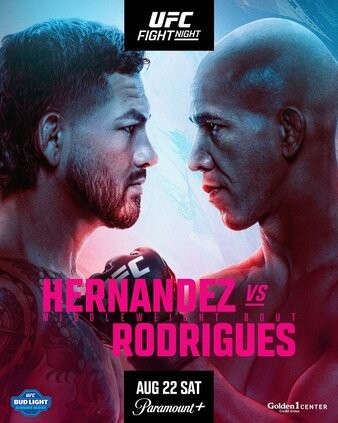
HernandezvsRodrigues

13Bouts
12Agree
1Splits
0Locks
UFC Fight Night: Hernandez vs. Rodrigues poster
Card complete. Claude 6/13 (46%)  ·  GPT 5/13 (38%)Results
RedBlue Bar: model avg Market KO Sub Dec
Main card
01
Main cardFinal: Rodrigues, U-DEC
Anthony Hernandez
Anthony
9-3UFC
32 yrs
VS
Middleweight
Gregory RodriguesWINNER
Gregory
10-3UFC
34 yrs
Claude + GPT
69%HernandezRodrigues31%
CLAUDE Anthony Hernandez 66% Submission, R4MISS
GPT Anthony Hernandez 72% KO/TKO, R4MISS
Why
CLAUDEThis is a classic pressure-grappler-versus-power-puncher matchup, and the deciding variable is the gap between Hernandez's takedown volume and Rodrigues's ability to keep the fight vertical for 25 minutes. Hernandez averages an enormous 5.88 takedowns per 15 minutes with a 1.6 sub average, and he compounds it with the best cardio at 185, his wins over Dolidze (R4 RNC), Pereira (R5 TKO) and Allen all came from drowning opponents in later rounds. Rodrigues's 75% takedown defense is real, but it has never been stress-tested by a chain-wrestler of this volume; Kopylov and Hermansson don't shoot five times a round. Rodrigues's path is clear and dangerous: he lands 5.53 SLpM at 51% accuracy with legitimate one-punch power (Ferreira and Hermansson both flattened in R1), and Hernandez was just knocked out by Sean Strickland six months ago, exposing a 51% striking defense that leaks head strikes when he's forced to strike. The Elo model calls this a coin flip (50/50) against a market at 66% for Hernandez, and that tension is fair, Rodrigues's live KO equity in rounds 1-2 is higher than the -215 line implies. But the fight's probability mass shifts steadily toward Hernandez every minute Rodrigues doesn't land the bomb: RDR's output fades under wrestling pressure, and Hernandez's back-take game (two recent RNC finishes) is the most reliable finishing sequence either man owns. I side with the market's direction but slightly below its number, taking Hernandez by late submission after accumulating rounds of grinding top pressure.
GPTHernandez's relentless wrestling, clinch pressure, and pace are well suited to neutralizing Rodrigues's superior one-shot power. Rodrigues owns solid 75% takedown defense and is dangerous early, but Hernandez attempts takedowns at a much higher rate, lands strikes more accurately, absorbs fewer significant strikes per minute, and should accumulate control and damage as Rodrigues fatigues. Over five rounds, Hernandez is favored to force a late stoppage through sustained ground-and-pound and attritional offense.
Stats
02
Main cardFinal: Petrino, U-DEC
Serghei Spivac
Serghei
9-5UFC
31 yrs
VS
Heavyweight
Vitor PetrinoWINNER
Vitor
6-2UFC
28 yrs
Claude + GPT
62%SpivacPetrino38%
CLAUDE Serghei Spivac 59% DecisionMISS
GPT Serghei Spivac 64% Submission, R2MISS
Why
CLAUDENo market line is available here, so this rests on UFC Stats and Elo, which scores it nearly even (51/49 Spivac). The stylistic question is whose grappling means more: Spivac is the proven heavyweight grappler, 3.82 TD/15 at a strong 59% accuracy, with submission wins over Derrick Lewis and Tybura, while Petrino is a converted light heavyweight whose 79% takedown defense was built against 205ers and two soft heavyweight tests (Petersen, Lane, Asplund, none ranked). Opposition quality is the separator: Spivac just outpointed the durable Ante Delija and has been in with Gane, Almeida, and Cortes Acosta, while Petrino's three-fight heavyweight streak came against the bottom of the division and he was knocked out by Jacoby and choked by Anthony Smith the moment competition improved at 205. Petrino is eight years younger, quicker, and defensively tidier on the feet (2.71 SApM vs Spivac's 4.23), so he can win rounds at kickboxing range if Spivac can't get hold of him. But Spivac's clinch entries against the fence are heavyweight-specific weapons Petrino hasn't faced, and Petrino's guillotine loss to Smith shows scramble vulnerabilities against real grapplers. Expect Spivac to absorb some early leather, then win rounds two and three with takedowns and heavy top control. Low confidence, both men have been finished recently and heavyweight variance is unforgiving.
GPTSpivac's size-adjusted heavyweight grappling, 3.82 takedowns per fight, and 59% takedown accuracy give him the clearest route to victory. Petrino owns strong 79% takedown defense and the superior striking differential, making him dangerous early, but sustained clinch pressure and chained trips should become harder to stop as the fight progresses. Spivac is favored to establish top control and secure a submission during a scramble or back-take.
Stats
03
Main cardFinal: Ridder, KO/TKO Punches
Reinier de RidderWINNER
Reinier de
2-3UFC
35 yrs
VS
Light Heavyweight
Roman Dolidze
Roman
9-4UFC
38 yrs13 mo out
Claude + GPT
65%RidderDolidze35%
CLAUDE Reinier de Ridder 62% Submission, R2HIT
GPT Reinier de Ridder 67% Submission, R2HIT
Why
CLAUDEThe market (-390, 77% implied) and Elo (60% for Dolidze) are in violent disagreement here, and the truth sits between them, closer to the market's side but well short of its number. Elo punishes de Ridder for his 2-3 UFC record on only five rated fights, but the losses were to Borralho and Allen, elite middleweights, while the wins (Whittaker, Nickal, Holland) are higher-quality scalps than anything on Dolidze's recent ledger. Dolidze arrives on his own two-fight skid, having been out-grappled and choked by Hernandez and outpointed by Christian Leroy Duncan, and his fatal statistical flaw is a 32% takedown defense, catastrophic against a decorated BJJ/judo grappler like de Ridder, even one whose 29% TD accuracy relies on clinch trips rather than shots. The move to light heavyweight helps RDR more than the raw numbers suggest: his losses came partly from depleted cardio at the 185 cut, and Dolidze is a former LHW who won't hold a size edge against the 6'4", 78-inch Dutchman. Dolidze's route is the one that beat RDR before, heavy hands in scrambles and against the fence, as Brendan Allen showed RDR's chin is breachable late. But Dolidze lacks Allen's pace and lands just 3.19 SLpM at 41% accuracy. Once RDR gets a body lock, the sequence to mount and neck is well-drilled. I'd price RDR nearer 65% than the market's 77%, the -390 line underweights his two-fight skid and chin questions, but he's still the correct side.
GPTDe Ridder's persistent clinch wrestling, positional grappling and submission chains are well suited to exploiting Dolidze's 32% takedown defense. Dolidze is dangerous on the mat and carries more striking power, but his negative striking differential and tendency to concede control should allow de Ridder to dictate where prolonged exchanges occur. After forcing Dolidze to defend repeated takedowns, de Ridder is favored to secure back control or a front-headlock submission in the middle rounds.
Stats
04
Main cardFinal: Judice, KO/TKO Kick
Carli JudiceWINNER
Carli
3-1UFC
27 yrs
VS
Women's Flyweight
Jeisla Chaves
Jeisla
29 yrs
Claude + GPT
67%JudiceChaves33%
CLAUDE Carli Judice 65% KO/TKO, R2HIT
GPT Carli Judice 68% DecisionHIT
Why
CLAUDEJudice is a legitimate -590 favorite and the tape supports the number. She's riding a three-fight UFC win streak with two violent finishes (knee TKO of Caliari, head-kick KO of Duben) and her output profile is elite for the division: 9.32 SLpM at 50% accuracy is nearly double Chaves' 4.97 SLpM. Critically, there is a direct comparative thread through Yuneisy Duben, Judice knocked Duben out in Round 1 (Mar 2025), while Chaves needed a split decision over the same opponent (Jun 2026). Chaves is 8-0 but effectively a UFC newcomer with only one Octagon appearance; both of her recorded recent wins were razor-thin split decisions with a 0% finish rate, and her UFCStats sample is too small to trust. Her 62% takedown defense hints at a grappling path if she tried, but her 1.5 TD/fight rate against Judice's 80% TDD suggests she won't be able to force the fight to the mat consistently. At kicking range, Judice's southpaw volume, knee/kick finishing arsenal, and pace should overwhelm Chaves by the midpoint. Confidence is capped due to Chaves' near-debut data void, undefeated fighters with hidden ceilings occasionally shock, but every observable signal points one direction. Judice's 6.62 SApM absorption is the one real vulnerability; if Chaves survives to Round 3 with her 56% accuracy counters, the split-decision specialist could steal rounds.
GPTJudice's exceptional striking pace and larger positive differential should allow her to bank rounds through sustained output. She lands 9.32 significant strikes per minute compared with Chaves' 4.97 and owns the stronger striking differential, 2.70 to 0.77. Chaves has the clearer grappling route, but her moderate takedown accuracy faces Judice's 80% takedown defense, making prolonged control uncertain. Judice's high absorption rate creates risk in exchanges, yet her volume and defensive wrestling favor her over three rounds.
Stats
05
Main cardFinal: Mederos, KO/TKO Punches
MarQuel MederosWINNER
MarQuel
3-0UFC
29 yrs15 mo out
VS
Lightweight
Mason Jones
Mason
3-3UFC
31 yrs
Claude + GPT
40%MederosJones60%
CLAUDE Mason Jones 58% DecisionMISS
GPT Mason Jones 62% DecisionMISS
Why
CLAUDEThis is the most interesting pricing tension on the card. The market makes Jones a strong -340 favorite (74%), but the opponent-adjusted Elo model actually favors Mederos 57-43, a genuine model-vs-market split worth resolving. Jones brings the pedigree: 18-2 overall, a three-fight UFC streak including an elbow TKO of Bolaji Oki, and a dual-threat game (5.61 SLpM plus 3.16 TD/fight at 45% accuracy). But his 46% striking defense is genuinely leaky, he absorbs 4.94 SApM and wins through attrition and pace rather than cleanliness. Mederos is the stylistic antidote on paper: unbeaten in the UFC (3-0-1), 63% striking defense, and a 90% takedown defense rate that should blunt Jones' wrestling entries and force a pure kickboxing fight where Jones eats counters. The problem for Mederos is offense, he's a 45%-accuracy, 4.39 SLpM decision grinder with zero UFC finishes who just fought to a majority draw against Chris Padilla, and he cedes 5 inches of reach. Jones' relentless forward pressure and volume edge should win the optics of close rounds, and his opposition quality (Onama, Klein, Stephens) exceeds Mederos' slate of Choinski/Hubbard/Quinones. I side with Jones by decision but at a materially lower probability than the market's 74%, closer to 60%. Mederos' takedown defense and cleaner defensive shell make him a live underdog, and the Elo signal (even discounted as provisional at 3 rated fights) confirms +275 is generous.
GPTJones' higher striking output and meaningful wrestling activity give him more ways to bank rounds, particularly through pressure, cage control, and takedown attempts. Mederos is the cleaner defensive striker and owns strong 90% takedown defense, but Jones' pace and five-inch reach advantage should help him create enough volume and control in a competitive fight.
Stats
Prelims
06
PrelimsFinal: Gaziev, KO/TKO Punch
Kennedy Nzechukwu
Kennedy
7-6UFC
34 yrs14 mo out
VS
Heavyweight
Shamil GazievWINNER
Shamil
3-2UFC
36 yrs
Claude + GPT
61%NzechukwuGaziev39%
CLAUDE Kennedy Nzechukwu 58% KO/TKO, R2MISS
GPT Kennedy Nzechukwu 64% KO/TKO, R2MISS
Why
CLAUDEThe market makes Gaziev a narrow -124 favorite, but Elo has this dead even (50/50) and the recent evidence tilts toward Nzechukwu. Gaziev has been knocked out with punches in back-to-back fights (Pericic, Cortes Acosta) and previously wilted from exhaustion against Rozenstruik, a durability and cardio profile that is deteriorating, reflected in his -27 Elo trend. Nzechukwu, despite the heel-hook loss to Walker, has looked comfortable at heavyweight as a striker, out-volumes Gaziev significantly (4.96 vs 2.94 SLPM), absorbs less relative to output, and owns a 5-inch reach edge as a southpaw against an orthodox opponent whose striking defense sits at just 45%. Gaziev's path is an early takedown-heavy grind, but Nzechukwu's 80% TD defense makes that difficult to sustain, and Gaziev historically empties his gas tank by round 2. Once this becomes a kickboxing match past the first round, Nzechukwu's length, volume, and Gaziev's demonstrated chin fragility point to a knockout. I disagree with the market lean here: it appears to be underweighting two consecutive first-round KO losses on Gaziev's ledger.
GPTNzechukwu's superior output, positive striking differential, five-inch reach advantage, and stronger striking defense give him the better tools to extend exchanges and punish Gaziev as the pace accumulates. Gaziev is dangerous early with power and wrestling, but his low output, 45% striking defense, and -1.98 significant-strike differential create a difficult matchup if he cannot secure sustained control. Nzechukwu's 80% takedown defense should help him keep enough of the fight standing to produce a second-round stoppage.
Stats
07
PrelimsFinal: McVey, KO/TKO Knee
Wes Schultz
Wes
30 yrs
VS
Middleweight
Jackson McVeyWINNER
Jackson
1-2UFC
27 yrs
Claude + GPT
60%SchultzMcVey40%
CLAUDE Wes Schultz 57% Submission, R2MISS
GPT Wes Schultz 62% Submission, R1MISS
Why
CLAUDEThe market prices McVey at 61%, but this specific stylistic pairing argues for the +144 underdog. McVey is a dangerous, accurate striker (6.51 SLPM, 69% accuracy) with a D'Arce win over Dumas, yet both of his UFC losses came by submission, armbar to Ferreira in round 1 and RNC to Reese in round 2. His grappling defense is the clearly exploitable hole in his game. Schultz is exactly the wrong opponent for that vulnerability: a submission hunter averaging 3.6 attempts per 15 minutes who has finished by guillotine and a Suloev stretch in his last two wins, showing creative, opportunistic finishing from any position. Schultz's own weakness is durability against power strikers (KO losses to Pinas and Abdul-Malik), so McVey's live path is genuine, this is a volatile fight where whoever imposes their phase first wins. But Schultz's 2.39 TDAvg means he only needs one or two entries to drag McVey into deep water where McVey has drowned twice in three UFC outings. With only 3 UFC fights for McVey and small samples on both sides, confidence stays modest, but the sub-defense-vs-sub-hunter mismatch is a specific, repeatable edge the market appears to be underweighting.
GPTMcVey owns the stronger striking metrics, landing 6.51 significant strikes per minute at 69% accuracy, but his 23% striking defense and unproven takedown defense create major vulnerabilities. Schultz's striking differential is negative and his takedown accuracy is only 21%, yet his 2.39 takedowns and 3.6 submission attempts per fight indicate a clear grappling route. In a matchup between submission-oriented fighters, Schultz's higher grappling activity should give him the better chance to force an early scramble and secure a finish, though the limited and inconsistent data keeps confidence moderate.
Stats
08
PrelimsFinal: Dyer, KO/TKO Punches
Shanelle DyerWINNER
Shanelle
25 yrs
VS
Women's Strawweight
Elise Reed
Elise
4-5UFC
33 yrs15 mo out
ClaudeGPT
75%DyerReed25%
CLAUDE Shanelle Dyer 80% KO/TKO, R3HIT
GPT Shanelle Dyer 69% DecisionHIT
Why
CLAUDEThis is one of the most lopsided lines on the card at -10000/+1100 (92% implied for Dyer), and everything in the data supports the direction if not the extremity. Dyer, 25, is a high-output finisher landing 7.71 significant strikes per minute with back-to-back KO/TKO wins by punches, while Reed, 33, has now been stopped by strikes in consecutive fights (Gomes, and the pattern of accumulating damage) and has lost 3 of her last 4. Reed's 3.41 SLPM output simply cannot keep pace with Dyer's volume, a 4.3 strikes-per-minute differential is enormous at strawweight, and Reed's paths to victory are narrow: her takedown game (0.46 TDAvg) is too infrequent to control a 100% TD-defense opponent, and she carries zero submission threat (0.0 SubAvg). Dyer holds height (5'6" vs 5'3") and reach (65" vs 63") advantages that compound her pressure striking. The one caution is Dyer's single-fight UFC sample and her decision loss to Carol Foro on DWCS, which shows she can be extended, so I temper confidence slightly below the market's extreme number. Expect Dyer to accumulate damage behind volume and break Reed late, consistent with Reed's declining durability.
GPTDyer's substantially higher striking output and stronger significant-strike differential should allow her to control the pace over three rounds. Reed is more accurate and has greater UFC experience, but she absorbs nearly as much as she lands and may struggle to match Dyer's activity. Dyer's reported 100% takedown defense also reduces Reed's limited secondary path through grappling, though Dyer's small sample and porous striking defense keep the matchup competitive.
Stats
09
PrelimsFinal: Wint, SUB Arm Triangle
Anthony WintWINNER
Anthony
30 yrs
VS
Heavyweight
Terrance Chatman
Terrance
29 yrs
Claude + GPT
62%WintChatman38%
CLAUDE Anthony Wint 65% KO/TKO, R1HIT
GPT Anthony Wint 58% KO/TKO, R1HIT
Why
CLAUDEBoth men are effectively UFC debutants, so this read leans on the market prior and what little verifiable data exists rather than octagon stats. Wint arrives unbeaten at 7-0 with a 100% finish rate, coming off a 12-day turnaround from a first-round KO of Matt Adams on the Contender Series, that short layoff means he is already in fight shape with an active camp, a meaningful edge at heavyweight where conditioning windows matter. The -1200 line (89% de-vigged) is one of the steepest on the card, and while I would not lay that price blind on a debutant, there is no statistical or stylistic evidence to fade it: Chatman is 5-1 with no recent fight log on file, suggesting inactivity. Heavyweight variance is real, one clean counter can flip any fight in this division, which is exactly why confidence is capped despite the lopsided market. Expect Wint to pressure early behind heavy hands and look for the same punch-finish pattern that got him signed.
GPTWint is the tentative pick based on the only measurable UFC data available, including 72% striking accuracy, an exceptional reported output, and perfect recorded striking and takedown defense. Those figures likely come from an extremely short sample and should not be treated as sustainable, while Chatman's missing statistics create substantial uncertainty. Wint's two-inch reach advantage and demonstrated offensive activity give him the clearest available path through an early stoppage.
Stats
10
PrelimsFinal: Emmers, KO/TKO Punch
Jamall EmmersWINNER
Jamall
5-4UFC
37 yrs
VS
Featherweight
Lerryan Douglas
Lerryan
31 yrs
Claude + GPT
38%EmmersDouglas62%
CLAUDE Lerryan Douglas 62% KO/TKO, R2MISS
GPT Lerryan Douglas 63% KO/TKO, R2MISS
Why
CLAUDEDouglas is the live prospect here and the market's -400 (77%) prior is directionally right, though I would price him closer to 70% given the sample size. His raw output is startling: 8.67 SLpM at 64% accuracy with a +3.85 strike differential, and he just knocked out the ultra-durable veteran Julian Erosa, a genuine quality-of-opposition data point, since Erosa is rarely finished. Emmers is a legitimate UFC veteran (5.3 SLpM, 90% TD defense) riding wins over Amil and Miranda, but the concerning pattern in his log is durability: he was flattened in round one by Nate Landwehr, and at 37 years old with a 288-day layoff, absorbing Douglas's volume is a dangerous proposition. Emmers's 90% takedown defense actually cuts against his best survival path, he historically prefers to strike, and his corner would need him to wrestle here (1.83 TD/fight at 40% accuracy gives him some tools). If Emmers can turn this into a grinding wrestling match he can steal rounds, which is why an upset is not absurd at +315, but the base case is Douglas's speed and accuracy finding the aging chin by the midpoint.
GPTDouglas projects as the more dangerous striker, producing substantially higher volume, accuracy, and net striking output while also holding a slight reach advantage. Emmers has the experience, a reliable positive striking differential, and a viable wrestling route, but his 4.05 significant strikes absorbed per minute creates risk against Douglas's speed and power. Douglas's UFC-level sample appears limited and his takedown defense is unproven, keeping confidence moderate, but his offensive striking upside favors a second-round stoppage after Emmers initially mixes in wrestling.
Stats
11
PrelimsSPLITFinal: Padilla, SUB Arm Triangle
Chris PadillaWINNER
Chris
4-0UFC
30 yrs
VS
Lightweight
Nasrat Haqparast
Nasrat
10-4UFC
31 yrs18 mo out
ClaudeGPT
47%PadillaHaqparast53%
CLAUDE Chris Padilla 58% DecisionHIT
GPT Nasrat Haqparast 64% DecisionMISS
Why
CLAUDEA genuine coin-flip on the line (-116/-102) and in Elo (1582 vs 1577, 51/49), so the pick hinges on trajectory and matchup mechanics. Padilla is unbeaten in the UFC at 4-0-1 with finishes in three modes, KO of Ismael Bonfim, sub of Llontop, decision over Herbert, and his +59 Elo trend is steeper than Haqparast's +36. Critically, Padilla brings a grappling dimension Haqparast cannot answer offensively: 3.26 takedowns per fight at 75% accuracy and 1.1 sub attempts, against a Haqparast who offers 0.28 TD/fight and zero submission threat. Haqparast's 84% takedown defense is genuinely good, so Padilla won't get free rides, but merely mixing in level changes will disrupt the German's rhythm-based southpaw boxing. Haqparast lands more volume (6.15 SLpM) but at only 44% accuracy versus Padilla's 61%, and Nasrat comes off a KO loss to Salkilld with a 302-day layoff. Padilla's own 46% striking defense is his liability, Haqparast can win a pure kickboxing match, but the 25-year-younger-feeling momentum, the extra phase of offense, and the fresher recent form tilt this slightly. Close, competitive, likely reaching the cards with Padilla banking rounds via takedown attempts and cleaner counters.
GPTPadilla has the stronger accuracy and grappling rates, but Haqparast's 84% takedown defense should limit those opportunities and keep the matchup primarily on the feet. Haqparast combines slightly higher striking volume with substantially better striking defense and has the experience to manage a competitive, high-output fight. Padilla's efficiency and pressure make this close, but Haqparast is more likely to win rounds through cleaner defensive exchanges and sustained southpaw boxing.
Stats
12
PrelimsFinal: Barbosa, KO/TKO Punch
Marcio BarbosaWINNER
Marcio
1-0UFC
28 yrs
VS
Featherweight
Ryan Kuse
Ryan
32 yrs
Claude + GPT
64%BarbosaKuse36%
CLAUDE Marcio Barbosa 65% KO/TKO, R1HIT
GPT Marcio Barbosa 63% DecisionHIT
Why
CLAUDEBarbosa is a legitimate knockout artist entering with real momentum: an 18-2 overall record, a first-round KO of Dennis Buzukja in his UFC debut, and a KO of Damon Wilson on Contender Series before that. His 8.27 SLpM volume paired with 47% accuracy indicates a swarming, front-foot power puncher who overwhelms opponents early. Kuse arrives as a UFC debutant at 9-2 with no UFC statistical footprint, so his numbers are unknowable rather than bad, but the -900 market line (86% de-vigged) signals sharps see a wide class gap, and short-notice regional debutants against proven DWCS/UFC finishers historically get finished early. The caveat: Barbosa's 50% strike defense and 7.56 SApM absorption suggest he's hittable in exchanges, giving a live puncher's chance to any debutant. Because Kuse is a complete unknown, confidence is capped despite the lopsided line. Barbosa's proven early power against a debutant absorbing UFC-level pace for the first time points to a first- or second-round stoppage.
GPTBarbosa is the more supportable pick because his available UFC sample shows exceptionally high output at 8.27 significant strikes landed per minute, 47% accuracy, a positive striking differential, and 100% takedown defense. His 7.56 strikes absorbed per minute and 50% striking defense create substantial risk, while Kuse's lack of recorded UFC data makes both his offensive ceiling and defensive reliability difficult to assess. Barbosa's demonstrated pace should win exchanges and rounds, but the defensive vulnerability and limited sample favor a cautious decision prediction rather than a high-confidence finish call.
Stats
13
PrelimsFinal: Dorsainvil, U-DEC
Gauge Young
Gauge
2-1UFC
26 yrs
VS
Lightweight
Stan DorsainvilWINNER
Stan
26 yrs
Claude + GPT
62%YoungDorsainvil38%
CLAUDE Gauge Young 61% DecisionMISS
GPT Gauge Young 62% DecisionMISS
Why
CLAUDEYoung is the rare debutant-opponent with a genuinely meaningful UFC resume: three full UFC fights including back-to-back decision wins over Thiago Moises (a longtime lightweight gatekeeper, a quality scalp) and Maheshate. His profile is that of a high-output decision grinder: 6.32 SLpM at 52% accuracy with a +1.2 strike differential, 76% takedown defense, and zero finishes in his logged run, every one of his last four fights went to the cards. Dorsainvil is 5-0 but making his UFC debut with no verifiable data; an unbeaten record over five regional fights is thin evidence against someone who just outpointed Moises. The market at -178 (62%) prices this correctly given the unknown, and I see no basis to diverge materially. Young's 49% strike defense means he eats shots, so a Dorsainvil with real power could make this uncomfortable, but Young's proven ability to win rounds against superior UFC competition and his 26-year-old upward trajectory (W-W after two close early losses) make him the sound pick. Expect a competitive but clear points win, Young simply doesn't finish people.
GPTYoung is the more supportable pick because he has demonstrated high-volume, accurate striking, producing a positive significant-strike differential of 1.20 per minute. His 76% takedown defense should also help keep the fight in his preferred phase. Dorsainvil's six-inch reach advantage presents a meaningful threat, while Young's 49% striking defense and 5.12 strikes absorbed per minute make a dominant performance unlikely. With no reliable UFC statistical sample for Dorsainvil, Young's proven output supports a competitive decision prediction rather than a high-confidence finish call.
Stats