Fight Genie logo Fight Genie
UFC 330 · August 15, 2026Final

MakhachevvsMachado Garry

12Bouts
10Agree
2Splits
0Locks
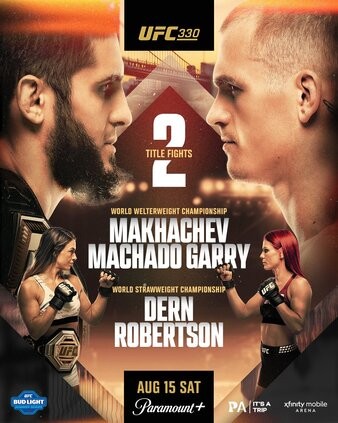
UFC 330: Makhachev vs. Machado Garry poster
Card complete. Claude 5/12 (42%)  ·  GPT 5/12 (42%)Results
RedBlue Bar: model avg Market KO Sub Dec
Main card
01
Main cardFinal: Makhachev, U-DEC
Islam MakhachevWINNER
Islam
17-1UFC
34 yrs
VS
Welterweight
Ian Machado Garry
Ian Machado
10-1UFC
28 yrs
Claude + GPT
75%MakhachevGarry25%
CLAUDE Islam Makhachev 75% Submission, R3HIT
GPT Islam Makhachev 74% Submission, R4HIT
Why
CLAUDEMakhachev already answered the welterweight size question by dominating Jack Della Maddalena over five rounds, and Garry presents a less dangerous version of that same problem. Garry's 80% takedown defense looks respectable on paper, but it has never been stress-tested by a chain wrestler of Makhachev's caliber, Shavkat Rakhmonov, a far less refined wrestler, was able to drag him into grinding grappling exchanges and win every card. Garry's path requires keeping this at kickboxing range for 25 minutes using his 4-inch reach and 4.78 SLpM volume, but Makhachev's 91% TD defense and 61% striking defense neutralize Garry's counter-wrestling threat (0.92 TD/fight, 31% accuracy is negligible offense against Islam). The Elo model (62/38) is softer than the market (74/26), but I side closer to the market: Elo underweights how stylistically tailored this is, Garry has zero UFC finishes in his last five and his only loss came to the one elite grappler he's faced. Makhachev's D'Arce sequences off scrambles (Poirier, Moicano) map directly onto Garry's tendency to give up his neck defending shots against the fence. Expect Garry to win striking moments in round 1 before Makhachev times a takedown and compounds control into a mid-fight submission.
GPTGarry's four-inch reach advantage, movement and 4.78 significant strikes landed per minute give him a credible path at distance. However, Makhachev absorbs only 1.45 significant strikes per minute and combines elite defense with far superior takedown efficiency and submission offense. Garry's 80% takedown defense is strong, but Makhachev's layered entries, fence wrestling and positional control are a substantially tougher test than a single-shot wrestling attack. Garry may win early striking phases, but repeated grappling exchanges should allow Makhachev to take over and secure a late submission.
Stats
02
Main cardFinal: Dern, U-DEC
Mackenzie DernWINNER
Mackenzie
11-5UFC
33 yrs
VS
Women's Strawweight
Gillian Robertson
Gillian
12-7UFC
31 yrs16 mo out
Claude + GPT
43%DernRobertson57%
CLAUDE Gillian Robertson 56% DecisionMISS
GPT Gillian Robertson 58% DecisionMISS
Why
CLAUDEThis is the clearest market-vs-model tension on the card. The market prices Dern at 64%, the public at 77%, but Elo has this nearly even (52/48), and the underlying data supports the Elo read. The common opponent thread is striking: Robertson knocked out Marina Rodriguez and just beat Amanda Lemos, the same Lemos who out-pointed Dern in 2024. Robertson rides a five-fight win streak with two KOs; her wrestling-first grappling (2.76 TD/fight at 40%) is the exact vector to exploit Dern's catastrophic 37% takedown defense and 18% takedown accuracy. Dern's entire threat is her ADCC-level guard, but Robertson is herself a submission grappler (0.9 sub avg) with the positional discipline to ride top position without diving into Dern's traps, she's spent her career playing exactly this game. Dern's recent wins (Jandiroba, Ribas) are legitimate, but Robertson is the fresher fighter (155-day layoff vs 295) with the more coherent gameplan path. Grappler-vs-grappler fights between sub specialists historically go to the better wrestler, and that's Robertson decisively. I disagree with the market by roughly 15 points: it's underweighting Robertson's top-control ceiling and overweighting Dern's name-brand jiu-jitsu.
GPTRobertson's superior takedown efficiency, positional wrestling, striking defense, and performance against the shared opponent give her more reliable paths to winning minutes. Dern can threaten submissions or reversals from almost any ground position, but her weak takedown accuracy and negative striking differential make sustained offensive control less dependable. Robertson is favored to manage the grappling exchanges carefully and edge a competitive decision.
Stats
03
Main cardFinal: Turner, KO/TKO Punches
Jalin TurnerWINNER
Jalin
8-6UFC
31 yrs
VS
Lightweight
Kaue Fernandes
Kaue
3-1UFC
31 yrs
Claude + GPT
39%TurnerFernandes61%
CLAUDE Kaue Fernandes 60% DecisionMISS
GPT Kaue Fernandes 62% DecisionMISS
Why
CLAUDEThe market has this a coin flip (-116/-104) while the public backs Turner 69/31 on name recognition and his Barboza KO, that 18-point gap is the tell, and I take the Fernandes side of it. Turner is the classic high-variance action fighter: 5.79 SLpM but a porous 41% striking defense and 4.54 SApM, with a 1-3 stretch before the Barboza win in which he was submitted in round 1 by Bahamondes and KO'd by Moicano. Barboza was a 39-year-old on a slide; that win says less than the losses. Fernandes is the opposite profile: +2.86 strike differential, 62% striking defense, 55% accuracy, and a rising Elo trend (+66 vs Turner's -12). His only UFC loss was a debut split decision to Diakiese, and he's since beaten a legitimately tough Kutateladze. The 6-inch height and 4-inch reach deficit is real, but Turner's defensive lapses when pressured, he retreats in straight lines and leaves his chin up, give Fernandes counter windows all night. Fernandes's durability and defensive discipline make him the live side at even money: he wins the exchanges on efficiency and takes rounds even when Turner has flashy moments early.
GPTTurner is the more dangerous early finisher and owns meaningful reach, volume, and submission threats, but Fernandes' cleaner accuracy, superior defense, and much lower absorption rate favor him over an extended striking fight. Fernandes should use disciplined movement and kicks to manage Turner's range, avoid early exchanges, and increasingly exploit Turner's defensive openings to win a competitive decision.
Stats
04
Main cardFinal: Stoltzfus, SUB Rear Naked Choke
Mansur Abdul-Malik
Mansur
2-1UFC
28 yrs
VS
Middleweight
Dustin StoltzfusWINNER
Dustin
2-8UFC
34 yrs
Claude + GPT
76%Abdul-MalikStoltzfus24%
CLAUDE Mansur Abdul-Malik 78% KO/TKO, R2MISS
GPT Mansur Abdul-Malik 74% KO/TKO, R1MISS
Why
CLAUDEThis is a rebound fight booked for Abdul-Malik after the Belgaroui knee KO, and Stoltzfus is a stylistically friendly opponent for that purpose. Stoltzfus is 2-8 in rated UFC bouts with a 46% takedown defense, the single most exploitable number in this matchup. His path to winning is grappling, but Abdul-Malik defends 83% of takedowns, which forces Stoltzfus into striking exchanges against a longer (80" vs 75" reach), harder-hitting, 6-years-younger man who has finished via KO in three of his last five wins. Stoltzfus also enters off a 337-day layoff and two straight decision losses where he was outworked by mid-tier opposition (Gastelum, Ruziboev). The one genuine caution: Abdul-Malik's chin was just cracked, his SApM (4.49) is high for a fighter this hyped, and Elo (66%) prices him well below the market's 85% because he's provisional with only 3 rated fights. I land closer to the market than Elo here, Elo can't see that Stoltzfus's losses came against notably better athletes than he is, and the physical mismatch is stark, but the -770 line leaves no betting value on the favorite straight. Abdul-Malik hurts him in exchanges and finishes on the ground or against the fence by mid-fight.
GPTStoltzfus has the more active submission profile, but his 37% takedown accuracy must overcome Abdul-Malik's strong 83% takedown defense. Abdul-Malik should therefore dictate where the fight takes place and exploit Stoltzfus's porous 46% takedown defense if needed. Although Abdul-Malik absorbs 4.49 significant strikes per minute, his athleticism, reach, and finishing power make him more likely to hurt Stoltzfus during early exchanges or transitions.
Stats
05
Main cardFinal: Ribovics, KO/TKO Punches
Edson Barboza
Edson
18-14UFC
40 yrs
VS
Lightweight
Esteban RibovicsWINNER
Esteban
3-3UFC
30 yrs
Claude + GPT
29%BarbozaRibovics71%
CLAUDE Esteban Ribovics 74% KO/TKO, R2HIT
GPT Esteban Ribovics 68% KO/TKO, R3HIT
Why
CLAUDEThere is a genuine signal conflict here worth naming: Elo makes Barboza a 54% favorite while the market has Ribovics at 85%. I side firmly with the market, because Elo is a lagging indicator that credits Barboza's 33-fight strength of schedule but cannot see the age cliff, he turns 40 before this bout, is on a 3-fight skid, and was starched in round one by Jalin Turner in his last outing. His -38 recent Elo trend is the tell inside his own rating. Ribovics's losses are honest ones: a razor-thin split to Haqparast and a submission to Gamrot, an elite grappler whose skill set Barboza does not share (0.43 TD/15min, so Ribovics's mediocre 66% TDD is irrelevant here). This becomes a pure kickboxing fight, and Ribovics throws 7.27 SLpM, nearly double Barboza's 4.14, with the durability of a 30-year-old against a legend whose chin has been failing against far lighter punchers than the McKinney-flattening Argentine. Barboza remains dangerous early with spinning kicks and the check hook, so round one carries real risk, but historically his losses follow a script: he gets touched, his output drops, and pressure finishes him. Expect Ribovics to walk him down and get a stoppage in rounds two or three as the accumulation tells.
GPTBarboza's kicking arsenal, reach, and counterstriking create substantial early danger, especially against an opponent absorbing 5.83 significant strikes per minute. However, Ribovics is the higher-output and more statistically efficient striker, and his sustained pressure should increasingly force Barboza into uncomfortable pocket exchanges. With neither fighter likely to prioritize wrestling, Ribovics' pace and durability favor him in a prolonged striking battle, with a late stoppage slightly more likely than a decision.
Stats
Prelims
06
PrelimsFinal: Njokuani, U-DEC
Chidi NjokuaniWINNER
Chidi
5-5UFC
37 yrs
VS
Welterweight
Joel Alvarez
Joel
8-3UFC
33 yrs
Claude + GPT
32%NjokuaniAlvarez68%
CLAUDE Joel Alvarez 72% Submission, R2MISS
GPT Joel Alvarez 64% Submission, R2MISS
Why
CLAUDEThis matchup is nearly a stylistic worst-case for Njokuani despite both men being listed as strikers. Njokuani's two-fight skid exposes the pattern: he was submitted in round one by Jake Matthews the moment the fight hit the floor, and outworked by Carlos Leal over 15 minutes. Alvarez, now a full-sized 6'3 welterweight after his move up from lightweight, is exactly the type of fighter who exploits both failure modes, he pressures with clinch knees (KO wins over Klose and Brener) and carries a genuine submission game (1.1 sub avg, D'Arce over Diakiese). Njokuani's 0.1 sub average and zero takedown offense mean he has no counter-threat in grappling exchanges. Alvarez's loss to Amosov is a quality loss to an elite grappler and shouldn't be over-read; his win over Vicente Luque at 170 proved the frame carries. Njokuani at 37 with a -5 Elo trend and 176-day layoff is fading, while Alvarez (Elo 1598 vs 1495) sits near his peak. The one path for Njokuani is his 61% striking accuracy and 3-inch reach at long range early, but Alvarez has shown he closes distance willingly and Njokuani historically wilts once fights leave his preferred kickboxing range. Market at 72% is fair; I side with it and expect a finish given Njokuani has been stopped in grappling exchanges before and Alvarez finishes 80% of his recent wins.
GPTNjokuani is the cleaner statistical striker, landing 5.16 significant strikes per minute at 61% accuracy with a +1.84 differential. Alvarez, however, absorbs slightly less damage and has a major grappling edge, averaging 1.1 submissions per fight compared with Njokuani's 0.1. Njokuani's 75% takedown defense makes a clean entry difficult, but Alvarez can create submission opportunities through clinch transitions and opportunistic scrambles rather than relying on high-volume wrestling. Expect Njokuani to have early striking success before Alvarez closes distance and attacks the neck or back.
Stats
07
PrelimsSPLITFinal: Johnson, SUB Twister
Charles JohnsonWINNER
Charles
7-6UFC
35 yrs
VS
Catch Weight
Eduardo Chapolin
Eduardo
30 yrs
ClaudeGPT
53%JohnsonChapolin47%
CLAUDE Eduardo Chapolin 58% DecisionMISS
GPT Charles Johnson 64% DecisionHIT
Why
CLAUDEThis is the spot where I side with the market against the public. Tapology has Johnson at 77% purely on name recognition, but the sportsbooks price this a coin flip (52/48), and the stylistic read actually tilts toward the debuting Brazilian. Johnson's losses form a clear template: he gets controlled by committed grapplers (submitted by Almabayev via Suloev stretch just 50 days ago, out-wrestled by Temirov) and clipped by power (Perez KO). Chapolin is precisely the first archetype, 5.0 takedowns per 15 at 83% accuracy on DWCS, a 15-2 record built on top control. Johnson's 66% takedown defense is respectable but not elite, and against a fresh, physically strong grappler with a full camp it tends to erode by rounds two and three. Concerns about Chapolin are real: a 348-day layoff since his DWCS decision, a short-notice-caliber step up in competition, and low striking output (2.47 SLPM at 40% accuracy) that could lose him rounds if takedowns fail. Johnson's path is clear, sprawl, keep it at range with his 3-inch reach and 4.54 SLPM volume, and bank rounds. But Johnson is also on 50 days' turnaround after being submitted, and quick turnarounds after grappling-heavy losses historically produce flat performances. I take the grappler by control-heavy decision, narrowly, and flag Johnson backers as over-paying at the community price.
GPTChapolin's wrestling is the primary obstacle, but his low striking output gives Johnson clearer paths to win minutes whenever the fight remains standing. Johnson is the more proven and active striker, carrying a positive striking differential while landing nearly twice Chapolin's volume. Chapolin can bank control time, but Johnson's movement, reach, and scrambling ability should limit sustained dominance and allow him to pull ahead over three rounds.
Stats
08
PrelimsFinal: Johnson, KO/TKO Punch
Donte JohnsonWINNER
Donte
1-0UFC
27 yrs
VS
Middleweight
Eric McConico
Eric
2-2UFC
36 yrs
Claude + GPT
68%JohnsonMcConico32%
CLAUDE Donte Johnson 67% DecisionHIT
GPT Donte Johnson 69% DecisionHIT
Why
CLAUDEThe rare fight with a direct common-opponent comparison: both men beat Cody Brundage by split decision, which tells us less about a gap than the market's -310 implies, and the Elo model agrees, giving Johnson only 53% on provisional data. The truth sits between. Johnson is 8-0 with genuinely well-rounded skills: 100% takedown accuracy, a guillotine finish of Dumas, 61% striking defense, and a +23 trend. McConico is a durable, game veteran at 36 whose only recent losses came via KO to heavy-handed finishers (Ruziboev, Susurkaev), a profile Johnson, at 3.11 SLPM with modest power, does not fit. That specific mismatch pushes me away from a KO prediction: McConico just went 15 minutes with submission ace Rodolfo Vieira and survived, showing his grappling defense is functional. Johnson's southpaw-vs-southpaw mirror neutralizes stance dynamics, and McConico's 3-inch reach and 4-inch height edge give him tools to make rounds competitive. But Johnson's superior defense (61% vs McConico's poor 45% StrDef), takedown threat, and 9-year age advantage should bank two of three rounds. The market at 73% is somewhat rich given McConico's durability against non-punchers and the tiny UFC sample on Johnson; I land closer to 67%, clearly favoring Johnson but expecting he has to work the full 15 minutes against a veteran who is very hard to put away without one-punch power.
GPTJohnson is the more efficient and defensively reliable fighter, landing slightly more while absorbing substantially less. His higher takedown output should also let him dictate where exchanges occur. McConico's reach and size advantages create risk, but his porous striking defense and negative differential favor Johnson over three rounds. Limited underlying sample information keeps confidence moderate.
Stats
09
PrelimsFinal: Gore, U-DEC
Vicente Luque
Vicente
17-8UFC
34 yrs
VS
Middleweight
Tresean GoreWINNER
Tresean
1-4UFC
32 yrs16 mo out
ClaudeGPT
67%LuqueGore33%
CLAUDE Vicente Luque 62% Submission, R2MISS
GPT Vicente Luque 72% KO/TKO, R2MISS
Why
CLAUDEThis is a rare card where market and public split, and I side against the market. The books make Gore a slight favorite (-116, 52% de-vigged), presumably pricing Luque's accumulated damage (5.24 SApM career, KO loss to Buckley, sub loss to Holland) and his move up to 185. But the opponent-adjusted Elo gap is enormous: Luque sits at 1622 across 25 rated fights against elite welterweight opposition, while Gore is 1456 with a 1-4 rated UFC mark whose wins came over Bekoev, Trocoli, and Fremd, the bottom tier of the division. Gore's 40% striking defense and 7.0 SApM absorbed are alarming numbers against a 50%-accurate, 4.8 SLPM pressure striker. The volume differential alone (Luque lands 4.8 vs Gore's 3.41 while Gore leaks strikes at nearly double the rate) points to Luque winning exchanges. The grappling wrinkle: both men live off front-headlock chokes, Luque has three anaconda finishes in his last four wins, Gore has three guillotine wins. But Luque's anaconda comes off sprawls against desperate shots, which is exactly what a hurt Gore offers. Gore's 83% TDD keeps this standing early, where Luque's pace and accuracy break him down, then the front headlock appears when Gore ducks under pressure. The market is underweighting Gore's strength-of-schedule problem; his losses came the moment he faced anyone competent (Vieira, Tulio, Battle, Brundage).
GPTLuque is the more proven and dangerous offensive fighter, while Gore's severe negative striking differential and porous defense are poor fits against Luque's accurate boxing and finishing power. Gore can compete through takedowns and physical grappling, especially given Luque's 59% takedown defense, but Luque is dangerous in transitions and owns the deeper submission arsenal. Luque's recent durability concerns and Gore's wrestling keep confidence moderate, yet the likeliest outcome is Luque hurting Gore during a striking exchange and securing a second-round stoppage.
Stats
10
PrelimsSPLITFinal: Fernando, KO/TKO Knee
Rafael Tobias
Rafael
23 yrs
VS
Light Heavyweight
Lucas FernandoWINNER
Lucas
29 yrs
ClaudeGPT
55%TobiasFernando45%
CLAUDE Lucas Fernando 57% DecisionHIT
GPT Rafael Tobias 67% Submission, R2MISS
Why
CLAUDEThe market is emphatic here (-295, 72%) and the public even more so (87%), but this line deserves skepticism rather than blind agreement. Fernando has not fought in 1,104 days, nearly triple the ~450-day threshold where ring rust becomes a material handicap, and his only data point on file is a decision LOSS to Cesar Almeida on the Contender Series in 2023. His statistical profile is thin and unflattering: 1.87 SLPM (extremely low output), 38% striking defense, and 0% recorded takedown defense. Tobias, meanwhile, is a 23-year-old with a 14-2 record who has actually been active, winning his DWCS bout by rear-naked choke before dropping a competitive decision to the highly-regarded Diyar Nurgozhay in his UFC debut. Tobias's 100% TDD and 1.6 subs/fight give him real paths to victory against a man who has never stopped a takedown in recorded UFC-adjacent competition. I still lean Fernando on the strength of the market signal and his 6-inch reach advantage (80 vs 74) plus superior striking accuracy (51% vs Tobias's poor 36%), but 72% implied is far too rich for a fighter coming off a three-year layoff whose last fight was a loss. This should be priced closer to 60/40, making Tobias at +240 one of the card's genuine value dogs even if Fernando remains the correct side.
GPTBoth fighters have negative striking differentials and poor striking defense, making sustained grappling exchanges likely. Fernando is the more accurate striker and has the reach advantage, but Tobias lands at a higher rate, has perfect recorded takedown defense, and faces an opponent with 0% takedown defense. Tobias' superior submission activity gives him the clearest finishing path, although the limited sample and incomplete weight-class data reduce confidence.
Stats
11
PrelimsFinal: Magny, KO/TKO Punches
Neil MagnyWINNER
Neil
23-12UFC
39 yrs
VS
Welterweight
Ramiz Brahimaj
Ramiz
3-5UFC
33 yrs
Claude + GPT
65%MagnyBrahimaj35%
CLAUDE Neil Magny 61% DecisionHIT
GPT Neil Magny 68% DecisionHIT
Why
CLAUDEThis is the card's clearest market/model conflict and I take Magny's side against the -154 line on Brahimaj. Elo makes Magny a 68% favorite (1606 vs 1479, a 128-point gap) while the market has him a +130 dog, a 26-point disagreement that demands resolution. The market's case is age and the Amosov choke-out: Magny is 39 and was anaconda-choked in round one last time out. But look at what each man has actually beaten. Brahimaj's three recent wins came over Austin Vanderford, Billy Ray Goff, and Mickey Gall, non-UFC-caliber opposition, and he lost a decision to Punahele Soriano the moment quality improved. Magny's recent losses came against Amosov, Prates, and Morales, three of the division's most dangerous fighters, while he was finishing Jake Matthews and Zaleski dos Santos in between. The common opponent is telling: Magny beat Max Griffin; Brahimaj was knocked out by him. Statistically, Magny out-lands (3.4 vs 2.29 SLPM), absorbs less (2.44 vs 3.27 SApM), and holds an 8-inch reach advantage (80" vs 72") behind a jab-and-clinch game built for exactly this kind of shorter, low-output grappler. Brahimaj's one path is the guillotine off Magny's sometimes-lazy shot entries, and his 44% TDD means Magny's 2.17 TD/fight wrestling will land. The risk is real, Magny's neck has been exposed, but Brahimaj is not Amosov, and 42% implied on Magny is too low for the massively more proven fighter. Magny grinds this out over three rounds with jabs, clinch control, and late takedowns.
GPTMagny's reach, higher output, superior striking differential, and clinch-wrestling experience should let him control most exchanges. Brahimaj has a meaningful submission path against Magny's 55% takedown defense, but his limited striking volume and defensive liabilities make sustained success less likely. Magny also performed better against their common opponent, Max Griffin. The most likely outcome is Magny surviving early grappling danger and winning rounds through range striking, clinch control, and opportunistic takedowns.
Stats
12
PrelimsFinal: Wells, SUB Guillotine Choke
Jeremiah WellsWINNER
Jeremiah
5-2UFC
39 yrs
VS
Welterweight
Myktybek Orolbai
Myktybek
4-0UFC
28 yrs
Claude + GPT
26%WellsOrolbai74%
CLAUDE Myktybek Orolbai 74% DecisionMISS
GPT Myktybek Orolbai 74% DecisionMISS
Why
CLAUDEThis is a classic prospect-vs-veteran gatekeeper matchup, and the trajectories point in opposite directions. Orolbai is 28, unbeaten in the UFC (4-0 rated), riding a three-fight streak with genuinely impressive scalps, a first-round KO of Jack Hermansson, a kimura of Tofiq Musayev, and a decision over the ultra-durable Chris Curtis. His Elo trend is +67 and climbing. Wells is 39, coming off a 288-day layoff, with a -29 Elo trend and a last-five of W-L-L-W-W where both losses came against mid-tier welterweights (Griffin decision, Harris anaconda choke). The technical crux: Orolbai attempts a staggering 8.77 takedowns per 15 minutes at 59% accuracy, while Wells defends takedowns at only 50%. Wells' path to victory is his own wrestling (3.06 TD/15) and early power, but Orolbai has never been finished and Wells' output (2.35 SLpM) is too low to win rounds he isn't controlling. That said, the market at -1200 (89%) is richer than the evidence supports, the Elo model gives Orolbai just 54%, his rating is provisional (4 fights), and his own 40% takedown defense means Wells' grappling entries are live, particularly in round one when Wells is most dangerous. I side with Orolbai firmly but see the true number closer to 78-80%, not 89%. Expect Orolbai to weather early Wells pressure, then impose chain wrestling and top control through rounds two and three as the 39-year-old's gas tank and layoff bite. Wells has never been submitted by anything other than a scramble choke, and Orolbai's grinding style points more to accumulation than a clean finish against a durable veteran.
GPTWells has credible early finishing threats, especially during chaotic grappling exchanges, but Orolbai is the more reliable minute winner. His substantially higher takedown output, superior takedown accuracy, and slightly better striking accuracy should allow him to dictate position and accumulate control. Wells' own wrestling could exploit Orolbai's 40% takedown defense, but matching Orolbai's pace across three rounds is the larger challenge. Orolbai is favored to survive the early danger and win a control-heavy decision.
Stats