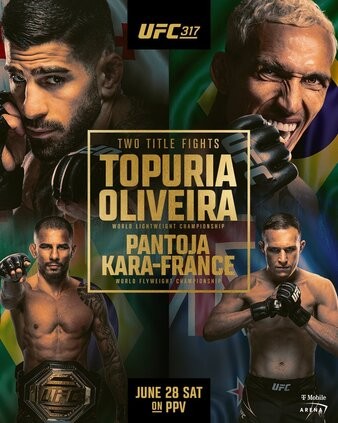
CLAUDETopuria's exceptional striking accuracy (47%) combined with his significant power advantage gives him a clear path to victory against Oliveira's vulnerable defense (49%). While Oliveira possesses a substantial submission threat (2.7 submissions per fight vs Topuria's 1.1), Topuria's elite takedown defense (92%) will likely neutralize Oliveira's grappling entries. Topuria's striking differential (+0.85) compared to Oliveira's (+0.19) indicates he'll land more effectively in exchanges. Oliveira has shown vulnerability to power punchers, and Topuria's perfect 14-0 record with 11 finishes demonstrates his ability to find the knockout against high-level competition. Topuria's defensive striking metrics (64% defense vs Oliveira's 49%) suggest he'll avoid Oliveira's dangerous counters while landing his own power shots.
GPTTopuria has a significantly higher strike defense and takedown defense, which will allow him to mitigate Oliveira's attacks and control the fight pace. His superior striking volume and accuracy could also grant him an edge in the stand-up exchanges.
CLAUDEPantoja holds a significant historical edge over Kara-France, having performed better against 7 of their 8 common opponents (87.5% win rate vs 50%). While Kara-France possesses superior striking defense (65% vs Pantoja's 50%) and a better striking differential (+1.34 vs Pantoja's +0.44), Pantoja's grappling advantage is decisive. Pantoja averages 2.61 takedowns per fight compared to Kara-France's 0.61, and his submission threat (0.8 per fight) adds a dimension Kara-France lacks. Pantoja's consistent high-level performances against elite competition, including a current 5-fight win streak, demonstrate his championship-level skills. Kara-France's takedown defense (88%) will make this competitive, but Pantoja's pressure fighting style, volume striking (4.41 SLPM), and phase-shifting abilities will likely earn him a decision victory in a competitive fight.
GPTPantoja has a higher win rate and effective strike rate, and has performed better against common opponents. Pantoja also has a stronger takedown game which could lead to control of the fight.
CLAUDEVan's extraordinary striking volume (8.39 SLPM vs Royval's 4.46) creates a significant offensive advantage that will be difficult for Royval to overcome. While Royval possesses better striking defense (47% vs Van's 58%), Van's superior takedown defense (83% vs Royval's 45%) will likely neutralize Royval's submission threat (1.2 per fight). Van's striking accuracy (53% vs Royval's 39%) indicates he'll land more effectively in exchanges. Van's youth advantage (22 vs 31) suggests better recovery and cardio for maintaining his high-volume approach. Royval's southpaw stance and 4-inch height advantage (5'9" vs 5'5") will create interesting range dynamics, but Van's reach disadvantage (65" vs 68") is mitigated by his forward pressure and volume. Van's recent performances show rapid improvement, while Royval has been inconsistent against elite competition.
GPTJoshua Van has a higher significant strike per minute rate (8.39 vs 4.46) and a higher striking accuracy (53% vs 39%). Additionally, Joshua's takedown defense is significantly better than Brandon's takedown accuracy, suggesting that Brandon might struggle to take the fight to the ground.
CLAUDEMoicano enters this bout with significant momentum, riding a 5-fight win streak while Dariush has dropped his last two by knockout. Moicano's striking metrics (4.42 SLPM vs Dariush's 3.78) give him a volume advantage, and his superior striking defense (60% vs 57%) should allow him to manage distance effectively. While Dariush has the better submission average (0.9 vs 0.6), Moicano's 72% takedown defense should be sufficient to keep the fight standing where his recent form suggests he has the advantage. Dariush's chin has shown vulnerability in recent outings, but Moicano's calculated approach is more likely to lead to a decision victory than a finish.
GPTBased on the statistical analysis, Moicano has a slight edge over Dariush in terms of striking volume and accuracy. While Dariush has a better takedown defense, Moicano's overall defensive efficiency and effective strike rate are superior. Also, Moicano has performed better against common opponents.
CLAUDETalbott presents a significant striking advantage with 8.38 SLPM compared to Lima's 3.29, creating a massive +5.09 differential. While Lima has better striking defense (64% vs 51%), Talbott's volume and accuracy (55%) will overwhelm Lima's defenses. Talbott's 90% takedown defense will neutralize Lima's grappling threat (1.33 TDAvg), keeping the fight standing where Talbott has a clear advantage. Talbott's switch stance will create angles that Lima's orthodox stance can't easily counter, and Talbott's 4-inch height advantage (5'10" vs 5'6") and 2-inch reach advantage (70" vs 68") will allow him to maintain optimal striking range. Talbott's recent form shows 3 consecutive KO/TKO victories, demonstrating his finishing power and technical striking improvements.
GPTTalbott's superior striking volume and accuracy, coupled with his excellent takedown defense, should give him the edge in this fight. While Lima has a decent takedown game, it is unlikely he will be able to control the fight on the ground given Talbott's defense. The fight will likely go the distance, with Talbott outpointing Lima on the feet.
CLAUDERodrigues holds key advantages in this matchup despite similar striking metrics. While Hermansson has slightly better striking defense (56% vs 51%), Rodrigues lands at higher volume (5.52 vs 5.09 SLPM) with better accuracy (56% vs 44%). The critical difference is in grappling - Rodrigues has 100% takedown defense compared to Hermansson's 80%, and superior takedown accuracy (41% vs 30%) with nearly twice the takedown average (2.74 vs 1.53). Rodrigues' recent form is exceptional with 4 wins in his last 5 fights, including 2 KO/TKO finishes, while Hermansson has gone 2-3 in his last 5. Rodrigues is also more active, fighting every 103.6 days on average compared to Hermansson's 232.4 days, indicating better conditioning and rhythm. Rodrigues' power advantage and superior grappling control will likely lead to a finish.
GPTGregory Rodrigues has a higher striking accuracy, volume, and takedown average. Although Jack Hermansson has a better takedown defense, Rodrigues' overall statistics give him a slight edge in this matchup.
CLAUDEThis matchup presents a classic striker vs grappler dynamic. Amil has superior striking defense (61% vs 48%) with similar volume (6.31 vs 6.23 SLPM), giving him a significant edge in striking exchanges. While Delgado has impressive takedown metrics (7.01 TDAvg, 75% accuracy), Amil's 78% takedown defense should be sufficient to keep the fight standing for extended periods. Amil's submission threat (1.9 SubAvg) provides a counter to Delgado's grappling, making Delgado potentially hesitant to engage on the ground. Amil's recent form shows 3 consecutive KO/TKO victories, demonstrating finishing power and technical striking improvements. Delgado's lack of UFC experience and 0% win rate in available data suggests he may struggle with the step up in competition. Amil's switch stance will create angles that Delgado will struggle to counter despite his 3-inch reach advantage.
GPTAmil's superior striking accuracy and defensive efficiency in combination with a strong takedown defense make him a solid pick. Delgado's striking accuracy and defense are weaker, which could lead to him absorbing more damage over the course of the fight. Even though Delgado has a high takedown average, Amil's strong takedown defense might nullify this advantage.
CLAUDECortez presents a more well-rounded skillset with superior striking differential (+0.70 vs -0.85) and comparable takedown ability. While Araujo has better takedown defense (78% vs 62%), Cortez's pressure-based approach and cleaner striking should allow her to control the pace. Araujo's recent form shows improvement with a win in her last bout, but Cortez's technical striking and ability to mix in takedowns will likely frustrate Araujo's attempts to establish her offense. Cortez's defensive striking (57% vs 56%) gives her a slight edge in exchanges, and her more efficient striking will accumulate points over three rounds.
GPTTracy Cortez has a slightly higher win rate and better striking differential. Although Viviane Araujo has a higher takedown defense, Cortez's takedown average per fight is superior, which may allow her to control the fight and score points with the judges.
CLAUDEThis matchup heavily favors McKinney's grappling against Borshchev's striking-heavy approach. McKinney averages 3.45 takedowns per fight with a 36% accuracy rate, while Borshchev has zero recorded takedowns and a concerning 35% takedown defense. The stylistic clash is significant - McKinney's explosive first-round finishing ability combined with Borshchev's grappling vulnerability creates a clear path to victory. While Borshchev is the superior striker (5.4 SLPM vs 4.53, 53% accuracy vs 50%), McKinney's 4-inch reach advantage and switch stance will help bridge the striking gap until he can secure a takedown. Their common opponent (Nazim Sadykhov) exposed Borshchev's grappling weaknesses, which McKinney is better positioned to exploit.
GPTGiven the significant difference in takedown defense, McKinney is likely to control the fight on the ground and potentially secure a submission win.
CLAUDEDespite Price's significant experience advantage, Smith's statistical profile reveals exceptional efficiency that could translate to UFC success. Smith's striking accuracy (76% vs Price's 42%) and volume (6.95 SLPM vs 5.21) indicate a technical advantage on the feet. More significantly, Smith's wrestling credentials shine through his 13.26 takedowns per fight at 87% accuracy, creating a clear path to control Price, who defends takedowns at just 52%. Price's wild, brawling style leads to defensive vulnerabilities (48% striking defense) that Smith's technical striking can exploit. While Price's experience and durability will make him dangerous throughout, Smith's wrestling control and more efficient striking should secure rounds on the scorecards.
GPTJacobe Smith has a significant advantage in striking, with a higher striking volume and accuracy than Niko Price. His takedown average is also significantly higher than Price's, suggesting a strong ground game. However, his takedown defense is notably weak, indicating a potential vulnerability.
CLAUDEDiniz brings significant striking advantages with a 4.09 SLPM and +1.34 striking differential, while Hines is making his UFC debut with limited data. Diniz has shown moderate upward trajectory with two recent wins including a KO/TKO victory in April 2024. His orthodox stance and 79" reach provide physical advantages that complement his high-volume striking approach. While Diniz's November 2024 loss raises questions, his 53% striking accuracy and 55% striking defense suggest technical proficiency that should overwhelm the less experienced Hines in the heavyweight division where finishing opportunities present themselves frequently.
GPTJhonata Diniz has a significantly higher striking accuracy and volume, as well as a superior defensive efficiency. Alvin Hines has no recorded stats, suggesting this may be his first professional fight or he has not had notable performances in the past.
CLAUDEWith both fighters making their UFC debuts and limited statistical data available, this prediction relies on subtle technical advantages. McVey's southpaw stance typically creates challenging angles for orthodox fighters, and at 26 years old compared to Ewert's 32, McVey likely possesses a slight athletic advantage. Middleweight debuts between relatively unknown quantities tend to be more tactical affairs, with fighters often adopting conservative approaches. McVey's southpaw stance should create openings for counter striking opportunities throughout a competitive three-round affair.
GPTBoth fighters lack statistical data and have no known record of performance. The prediction is based on limited data available.

 1